







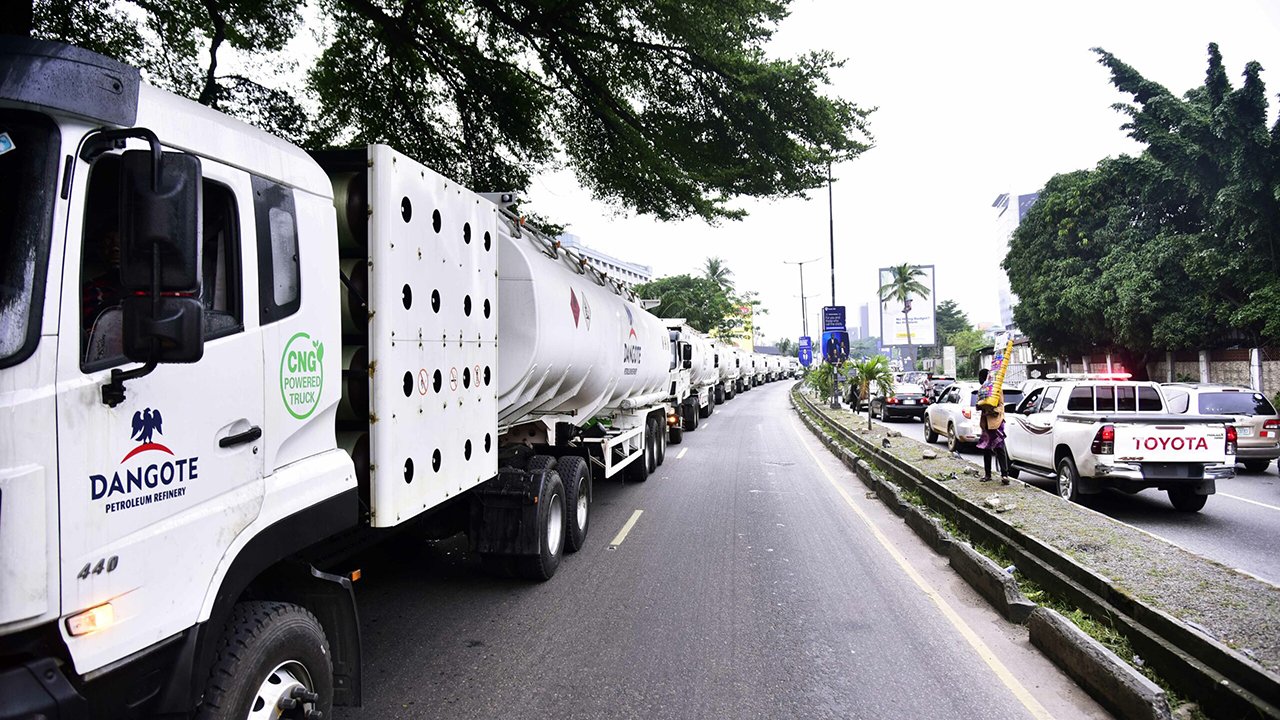
![Dangote Petroleum Refinery secures daily distribution of up to 65 million litres of petrol, strengthening Nigeria’s fuel self-sufficiency. [Guardian]](https://ocdn.eu/pulscms/MDA_/94af08824e5d03611081be6a18c9b011.jpg)
Nigeria’s push towards fuel self-sufficiency has gained fresh momentum after the Dangote Petroleum Refinery signed an offtake agreement with 12 major marketers to distribute up to 65 million litres of petrol daily across the country.
- Nigeria’s Dangote Petroleum Refinery has signed a landmark offtake agreement with 12 marketers to supply up to 65 million litres of petrol daily.
- The deal aims to stabilise domestic fuel supply and create export potential.
- Regulatory backing ensures efficient logistics, curbing hoarding and price volatility.
- Experts say this marks a turning point in Nigeria’s energy independence and industrial capability.
The deal, disclosed in Lagos by billionaire industrialist Aliko Dangote, is designed to guarantee nationwide availability of Premium Motor Spirit while positioning the refinery to export excess production.
“We have agreed an offtake framework to supply up to 65 million litres daily for the domestic market. Any surplus, estimated at between 15 and 20 million litres, will be exported,” Dangote said.
Nigeria’s daily petrol consumption is currently estimated at between 50 million and 60 million litres, meaning the new arrangement could comfortably meet local demand while creating export headroom. On a monthly basis, the refinery is projected to release between 1.8 and 2 billion litres, depending on output levels.
The structured distribution model follows an earlier October 2025 understanding between the refinery and downstream operators aimed at calming supply disruptions and moderating pump price volatility. Independent marketers had previously indicated that the facility planned to release up to 600 million litres per month into the domestic market.
Regulatory backing has come from the Nigerian Midstream and Downstream Petroleum Regulatory Authority, which endorsed the framework as part of broader reforms to curb hoarding and speculative trading.
Under the arrangement, nationwide logistics will be handled by a consortium of marketers, including MRS Oil Nigeria Plc, Nigerian National Petroleum Company Limited Retail, 11 Plc, TotalEnergies Marketing Nigeria, Rainoil Limited, Northwest Petroleum & Gas Company Limited, Ardova Plc, Bovas & Company Limited, AA Rano Nigeria Limited, AYM Shafa Limited, Conoil Plc, and Masters Energy.
According to the refinery, the model is intended to improve logistics efficiency, reduce product hoarding, and support price stability across Nigeria’s fragmented downstream market.
Industry stakeholders say the development could ease long-standing supply pressures in Africa’s largest oil producer, which has relied heavily on imported refined products for decades. That dependence exposed the economy to currency volatility, global supply shocks, and periodic fuel scarcity.
Refinery as a Transformative National Asset
![A general view of Dangote Petroleum Refinery Petrochemicals in Lagos, on May 22, 2023. Nigerian President Muhammadu Buhari has inaugurated Dangote Petroleum Refinery and Petrochemicals, the largest single-train refinery in the world with 650,000 barrels per day refining capacity. [Photo by PIUS UTOMI EKPEI/AFP via Getty Images]](https://ocdn.eu/pulscms/MDA_/852917205edbaca51dc9b9f9ee90a000.jpg)
The Group Chief Executive Officer of the Nigerian National Petroleum Company Limited, Bayo Bashir Ojulari, recently described the refinery as a transformative national asset. He noted that the plant, originally designed for 650,000 barrels per day, had demonstrated higher live operating parameters during recent technical reviews.
Energy analysts view the latest agreement as closely aligned with the broader downstream reforms introduced under President Bola Tinubu, whose administration removed petrol subsidies and liberalised the market.
If fully implemented, the Dangote offtake framework could mark a turning point for Nigeria’s fuel supply chain, helping to stabilise domestic availability while positioning the country as a net exporter of refined petroleum products across West and Central Africa.