






Africa has emerged as one of Diageo’s strongest-performing regions just as the British drinks giant prepares to relinquish direct ownership of its remaining beer business on the continent.
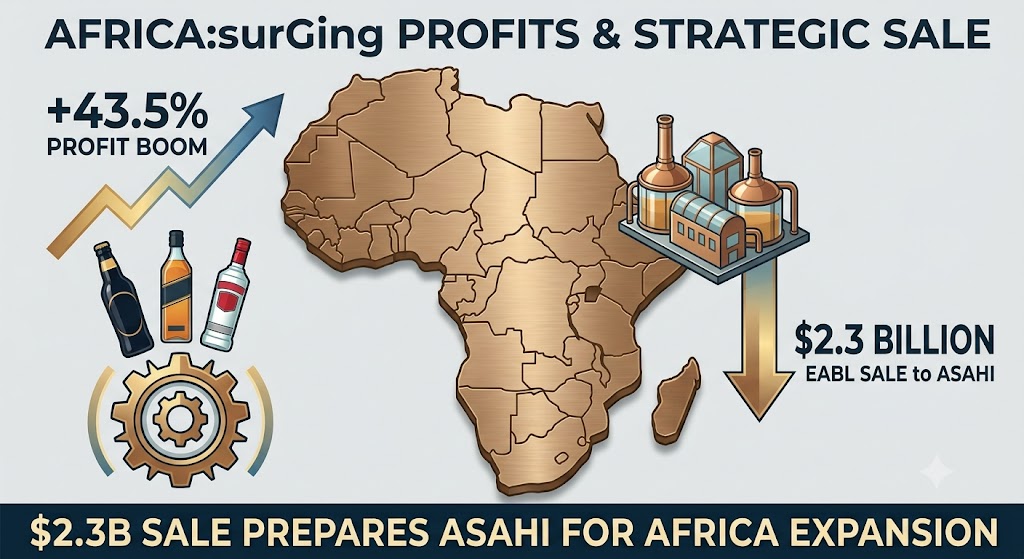
- Diageo’s Africa operating profit surged 43.5%, making it the company’s fastest-growing major region.
- Organic sales rose 13.3%, despite the group’s global sales declining 2%.
- The growth comes as Diageo prepares to sell its 65% EABL stake to Japan’s Asahi for $2.3 billion.
- The deal reflects Diageo’s shift to an asset-light model while keeping its brands in Africa.
Diageo’s organic operating profit in Africa jumped 43.5% in the year ended June 30, 2026, the strongest growth across its major geographic regions, according to preliminary results released on Thursday.
Organic net sales in Africa increased 13.3%, supported by a 14% increase in volumes. That performance contrasted sharply with Diageo globally, where organic net sales declined 2% and reported net sales fell 3% to $19.64 billion.
Africa’s growth was broad-based. Spirits and ready-to-drink products recorded double-digit growth, while beer grew by high single digits. Diageo attributed the improvement partly to changes in its routes to market and product innovation.
The numbers present an unusual backdrop to one of Diageo’s biggest strategic shifts in Africa.
The company is pressing ahead with the sale of its 65% stake in East African Breweries Plc (EABL), alongside its interest in Kenyan spirits company UDV Kenya, to Japan’s Asahi Group Holdings.
Diageo expects approximately $2.3 billion in net proceeds after taxes and transaction costs. The deal implies an enterprise value of approximately $4.8 billion for EABL and values the transaction at about 17 times adjusted EBITDA.
Diageo confirmed in Thursday’s results that the transaction remains on track to close during the second half of 2026.
The company expects the disposal to reduce its net debt-to-adjusted EBITDA ratio by approximately 0.25 times. At the end of June, Diageo carried net debt of $20.48 billion, down from $21.85 billion a year earlier.
DON’T MISS THIS: World’s largest spirits maker, Diageo, sells stake in East African Breweries for $2.3 bln
The deal would also mark a major expansion into Africa for Asahi. Diageo described the transaction when it was announced in December as the first investment of this scale in an African alcoholic-beverage business by a major Japanese brewer.
Africa grows as Diageo retreats from brewery ownership
Diageo’s decision to sell EABL does not amount to a withdrawal of its brands from Africa. Instead, it represents the culmination of a broader shift towards an asset-light model, in which the company retains ownership of international brands while relying increasingly on local or regional partners for production and distribution.
The company has spent the past few years reducing direct ownership of African breweries.
It sold its controlling stake in Guinness Nigeria to Singapore-based Tolaram in 2024, its 80.4% holding in Guinness Ghana to France’s Castel Group for $81 million, and its 54.4% interest in Seychelles Breweries to Mauritius-based Phoenix Beverages for about $80 million.
Diageo itself has described these transactions as part of a move towards an asset-light model across parts of Africa, designed partly to improve balance-sheet flexibility.
Those disposals are also visible in the latest numbers.
Despite the 13.3% increase in organic African sales, reported net sales from the region actually fell 10.5% to $1.64 billion, largely because the disposals of businesses in Nigeria, Ghana and Seychelles removed their revenues from Diageo’s consolidated accounts.
That distinction is important: the decline in reported revenue does not indicate that Diageo’s continuing African operations shrank. On an underlying basis, the business expanded strongly.
DON’T MISS THIS:The family behind Indomie made a $70 million bet on Guinness Nigeria when multinationals were leaving. It’s now worth over $350 million
Indeed, Africa accounted for 8% of Diageo’s global net sales during the year. Its organic sales growth of 13.3% was substantially ahead of Europe at 3.4% and Latin America and the Caribbean at 7.7%, while North America and Asia Pacific contracted by 8.4% and 6.3%, respectively.
Africa also delivered the strongest organic operating-profit growth, at 43.5%.
East Africa remains a growth engine
Perhaps the most striking part of the results is the performance of the business Diageo is preparing to sell.
East African net sales increased 12.6%, with double-digit growth in Uganda and Tanzania and mid-single-digit growth in Kenya. Diageo said strong beer and rum sales helped drive the performance, alongside local flavour innovation in Kenya.
South, West and Central Africa performed even better, with organic net sales growing 15.2%, supported particularly by strong growth in South Africa.
The strength of East Africa makes the EABL transaction less a disposal of an underperforming business than a strategic decision to monetise one of Diageo’s most valuable African holdings.
DON’T MISS THIS:World’s largest spirits maker, Diageo, sells stake in East African Breweries for $2.3 bln
Diageo acquired majority control of EABL in 2000. The brewer has since grown into one of East Africa’s largest listed consumer companies, with major operations in Kenya, Uganda and Tanzania.
The $2.3 billion transaction has nevertheless faced legal challenges in Kenya. Several attempts have been made to stop or delay the transfer, including disputes involving distributors and minority-shareholder concerns. Diageo’s latest statement maintains that completion remains on schedule for the second half of this year.
Under the deal, Diageo will not disappear from EABL’s shelves after Asahi takes control.
Long-term licensing agreements are expected to allow EABL to continue producing and distributing Guinness and several other Diageo products, while also distributing Diageo’s international spirits portfolio. EABL will retain ownership of its local brands.
Globally, Diageo reported net profit of $1.96 billion, down 22.9%, while reported operating profit fell 27.2% to $3.16 billion.
Against that backdrop, Africa’s 43.5% organic operating-profit growth stands out even more, and the pending $2.3 billion EABL transaction shows that Diageo is increasingly betting that it can capture that growth without owning the breweries behind it.