





Japan is investing up to $34 million (C$47.7 million) in a heavy rare earth mining project in Namibia, strengthening Africa’s position in the global race to secure critical minerals used in electric vehicles, renewable energy and defence technologies.
- Japan will invest up to $34 million (C$47.7 million) in a heavy rare earth project in Namibia as it seeks to diversify supplies of critical minerals.
- The Lofdal project is expected to become Japan’s first rare earth mine development in Africa.
- The mine contains dysprosium and terbium, key materials used in electric vehicles, wind turbines and defence technologies.
- The investment underscores Namibia’s growing role as a strategic supplier in the global critical minerals race.
Japan’s state-backed Japan Organization for Metals and Energy Security (JOGMEC) said on Thursday it would invest in TJ Namibia Rare Earths, a special purpose company established by Toyota Tsusho to develop the Lofdal Heavy Rare Earth Project in Namibia’s Kunene Region. The initial investment was made on July 23.
The partners plan to complete a definitive feasibility study before making a final investment decision during Japan’s 2026 financial year, which ends in March 2027.
The project is expected to become Japan’s first rare earth mine development in Africa, marking a significant milestone in Tokyo’s efforts to build more resilient supply chains for critical minerals.
DON’T MISS THIS:Africa’s rare earth ambitions take a step beyond mining as Namibia backs higher-value processing
The Lofdal deposit contains substantial reserves of dysprosium and terbium, heavy rare earth elements essential for manufacturing high-performance permanent magnets used in electric vehicle motors, wind turbines, robotics and advanced defence systems.
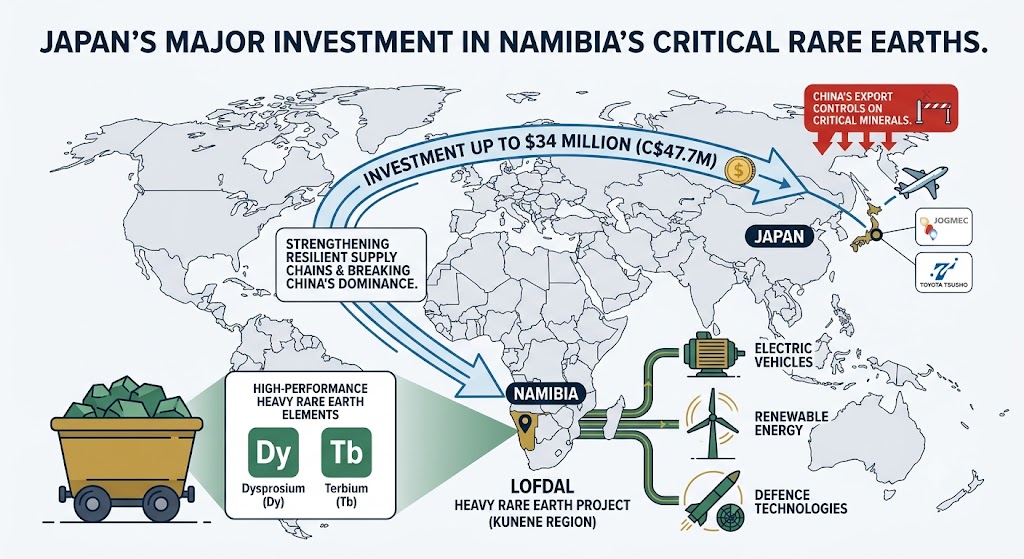
The investment comes as major economies scramble to reduce their dependence on China, which dominates the global supply chain for rare earth mining and processing.
Beijing tightened export controls on several heavy rare earth elements and related magnets over the past year, prompting countries including Japan to accelerate efforts to secure alternative sources of supply.
DON’T MISS THIS:Namibia moves to position itself as the next major force in critical minerals and rare earths
The Lofdal project began in 2020 as a joint exploration venture between JOGMEC and Canada’s Namibia Critical Metals.
Toyota Tsusho joined the project in March this year after acquiring part of JOGMEC’s interest through a competitive bidding process, paving the way for the creation of the new project company.
For Namibia, the latest investment reinforces its emergence as one of Africa’s most attractive destinations for critical minerals investment.
DON’T MISS THIS: Japanese multi-billionaire company Toyota Tsusho to invest additional $32 million in rare earth mining in Namibia
The southern African nation has drawn growing international interest in recent years as companies seek new sources of uranium, lithium, copper and rare earth elements needed for the global energy transition.
The deal also highlights Africa’s increasingly strategic role in global supply chains. While the continent has long been a major source of raw materials, rising demand for minerals used in electric vehicles, batteries and clean energy technologies is attracting fresh investment from governments and companies seeking to diversify away from traditional suppliers.
If commercial production proceeds as planned, the Lofdal mine could become an important new supplier of heavy rare earths at a time when demand is expected to rise sharply as the global transition to cleaner energy and advanced manufacturing gathers pace.