





Morocco’s OCP Group is preparing to build America’s first new phosphate-fertiliser plant in more than four decades as part of a proposed investment worth up to $450 million.
- Morocco’s OCP and American farmer-owned cooperative CHS plan to build a fertiliser plant in Louisiana.
- The companies expect to invest up to $450 million in a facility producing more than one million tonnes annually.
- It would be the first comparable US phosphate-fertiliser plant built since 1984.
- The project still requires funding and regulatory approvals, and construction has not begun.
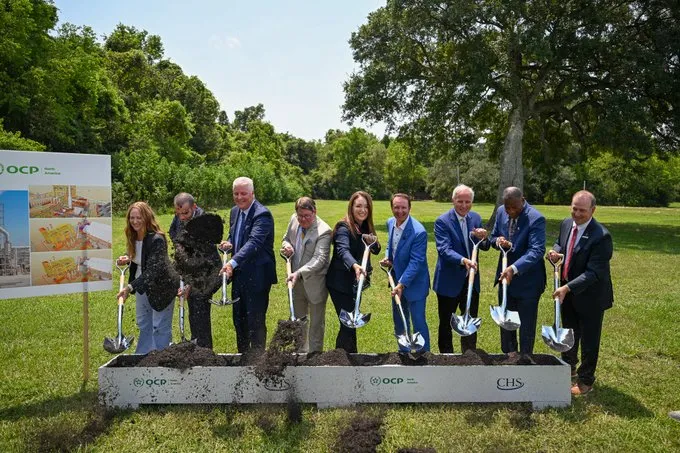
OCP North America and CHS, the largest farmer-owned cooperative in the United States, announced plans on 26 August to form a joint venture for the factory.
The facility would be located at the Cornerstone Energy Park in Waggaman, Louisiana, close to the Mississippi River.
It is expected to produce more than one million tonnes of phosphate-based fertiliser annually.
If approved and completed, the companies say it would be the first plant of its kind built in the United States since 1984.
Moroccan raw material, American production
OCP Group would supply phosphoric acid to the Louisiana factory. The acid is produced from phosphate rock and is a central input in the manufacture of fertiliser used on crops including maize, wheat and soybeans.
DON’T MISS THIS: France to back Morocco’s power link to Western Sahara
Finished products from the factory would be distributed through OCP North America and CHS’s network of agricultural cooperatives, retailers and farmers.
The structure would allow OCP to move further into manufacturing inside one of the world’s largest agricultural markets instead of supplying only imported finished fertiliser.
It would also connect Morocco’s enormous phosphate resources directly to American manufacturing and food production.
Morocco holds the world’s largest known phosphate-rock reserves. OCP, which is controlled by the Moroccan state, has become one of the world’s most influential suppliers of phosphate fertilisers.
America imports 40% of what its farmers use
The companies said the United States imports approximately 40% of the phosphate fertiliser required by its farmers.
They estimate that the proposed Louisiana factory could reduce that import dependence by more than 48%.
That figure is a company projection. It has not been independently tested, and the plant would still rely on phosphoric acid supplied by Morocco.
DON’T MISS THIS: Middle East conflict tightens fertiliser exports as Africa’s food security wavers
The factory would therefore increase the amount of fertiliser manufactured on American soil without making the supply chain entirely domestic.
Locating the plant near the Mississippi River would give it access to raw materials and allow finished fertiliser to be transported through one of America’s most important agricultural logistics systems.
The project also arrives as food-producing countries seek greater control over fertiliser supplies following disruptions caused by wars, sanctions, higher energy prices and export restrictions.
Phosphate is one of the three principal nutrients used in commercial fertiliser, alongside nitrogen and potassium.
Funding and approvals are still required
OCP and CHS have not made a final investment decision. The project remains subject to funding, regulatory reviews, engineering work and other approvals.
The companies have applied for possible support through the US Department of Agriculture’s Fertilizer Investment and Expansion for Long-term Domestic Supply programme.
Construction is expected to take up to 24 months after the necessary approvals are secured.
The partners did not disclose how ownership of the proposed joint venture would be divided or how much each company would contribute to the investment. They also did not provide a firm opening date.
Jobs and a deeper US presence
The factory is expected to create approximately 500 construction jobs and 60 permanent positions.
The companies estimate that its total economic effect could support 924 direct and service-related jobs.
CHS generated revenue of $35.5 billion during its 2025 financial year and serves customers in 65 countries.
Its local distribution network would give OCP access to American farmers without requiring the Moroccan company to construct an entirely new sales system.
For OCP, the transaction could provide a template for moving closer to major customers while maintaining Morocco’s role at the centre of the supply chain.
For the United States, it offers additional production capacity at home, but with a critical African input.
The result is not a retreat from fertiliser imports. It is a proposed reorganisation of them, with Moroccan phosphate processed into finished products inside America.