







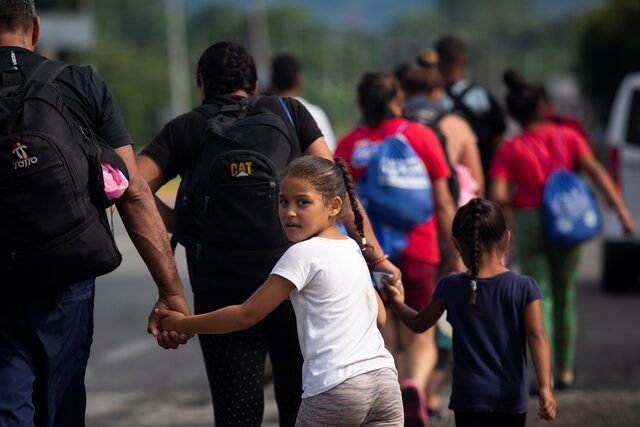
![Children hold their parents' hands as they walk with other migrants in a caravan toward the U.S. border. [ Image Credit: REUTERS/Quetzalli Nicte-Ha]](https://ocdn.eu/pulscms/MDA_/5b2d4cf92f417a2e5df35974cff07222.jpg)
Under the second Trump administration, an estimated 35,000 children in the U.S. have had both of their parents deported, leaving thousands of minors without legal guardians or financial support.
- An estimated 35,000 US-citizen children have lost both parents to deportation during the second Trump administration.
- Federal immigration enforcement now prioritizes rapid deportations, bypassing previous requirements for guardianship or family reunification arrangements.
- Many undocumented parents, including asylum seekers, are being deported separately from their American-citizen children, often after routine encounters with law enforcement.
- The Trump administration has also expanded secretive agreements to transfer over 25,000 migrants to 29 foreign countries, including 14 African nations, with more than $49 million in US funding.
This growing domestic family crisis unfolds alongside a massive expansion of international removal agreements, which have transferred over 25,000 migrants to 29 foreign countries including 14 African nations backed by more than $49 million in direct U.S. government funding.
Federal immigration enforcement has prioritized rapid removals, forcing thousands of American-citizen children into precarious living situations while sending non-citizens to unfamiliar foreign territories.
Over 35,000 children in the U.S. left without caregivers as parents are deported to Venezuela
Recent data from the Brookings Institution reveals that more than 35,000 children across the United States have lost both caregivers to sudden federal deportations.
This widespread separation occurs primarily because the affected children hold U.S. citizenship, while their undocumented parents are subject to immediate removal from the country.
Changes to federal guidelines in 2025 allow Immigration and Customs Enforcement (ICE) officers to bypass previous policies that required establishing guardianship plans or arranging joint family reunifications prior to deportation.

As a result, many undocumented parents who entered the country legally to seek asylum such as a mother detained during a routine traffic stop in Alabama and subsequently deported to Venezuela are removed without their young children.
Atlantic staff writer Caitlin Dickerson, documented these family separations on Texas Standard, explained that “there’s just so much pressure to carry out deportations as quickly as possible, to hit those numbers that President Trump campaigned on and so desperately wants, that the priority has just become deportation over everything else — including over children“.
Without formal legal guardians or state intervention, neighbors and coworkers frequently step in as temporary caregivers, facing extreme economic hardship and housing instability.
Trump administration expands third-country deportation agreements across 14 African nations
The U.S. government has also established a secretive network of bilateral deals to transfer non-citizen migrants, refugees, and asylum seekers to foreign third countries.
According to tracking data compiled by Third Country Deportation Watch, (a joint project by Refugees International and Human Rights First) the network encompasses 14 African countries, including:
“Eswatini, Burundi, Cameroon, Cabo Verde, Central African Republic, Democratic Republic of the Congo, Equatorial Guinea, Ghana, Liberia, Libya, Rwanda, Sierra Leone, South Sudan, Uganda”
The program includes explicit arrangements to incarcerate forcibly transferred individuals in foreign prisons, such as facilities in Eswatini, El Salvador, and South Sudan.
A Senate Foreign Relations Committee Minority Report noted that “deportation is being used as a bargaining chip. U.S. diplomacy is being conducted through secret cash payments and quiet concessions“.