







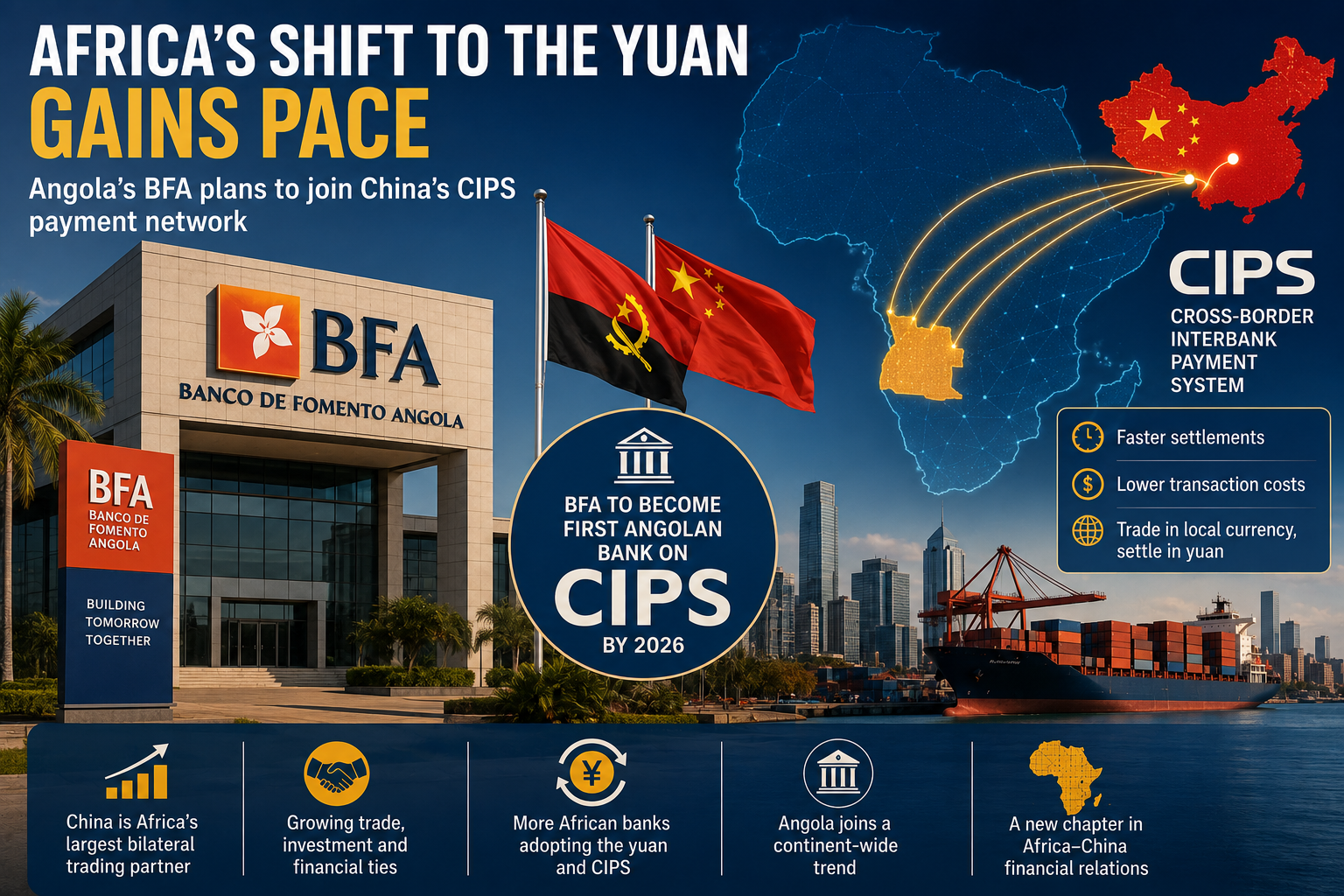
China’s campaign to expand the global use of the yuan is gaining fresh momentum in Africa, with Angola becoming the latest country to deepen its integration with Beijing’s financial system as one of its biggest commercial banks prepares to join China’s Cross-Border Interbank Payment System (CIPS).
- Angola’s Banco de Fomento Angola plans to become the country’s first bank to join China’s CIPS payment network.
- The move reflects Africa’s growing use of the yuan for cross-border trade as economic ties with China deepen.
- Joining CIPS could reduce transaction costs and make payments to Chinese businesses faster and more efficient.
- It also underscores China’s expanding influence on Africa’s financial infrastructure, even as the U.S. dollar remains dominant.
Banco de Fomento Angola (BFA), the country’s second-largest commercial lender, plans to become the first Angolan bank to connect directly to CIPS by next year, responding to growing demand from businesses trading with China.
The decision marks another step in Africa’s gradual shift towards settling more cross-border transactions in China’s currency rather than the U.S. dollar.
DON’T MISS THIS: China’s push for a global yuan gains ground in one of Africa’s biggest oil economies
The development comes as China cements its position as Africa’s largest bilateral trading partner.
Trade between China and Africa has continued to expand, supported by Beijing’s decision to remove tariffs on imports from 53 African countries and growing Chinese investment in sectors ranging from infrastructure and mining to manufacturing and agriculture.
As trade volumes rise, more African businesses are asking banks to settle payments directly in yuan instead of first converting them into U.S. dollars.
Why Angola matters
Few African countries illustrate China’s economic influence better than Angola.
The oil-rich Southern African nation is one of China’s largest crude oil suppliers, while Chinese lenders have provided billions of dollars in financing for roads, railways, housing and energy projects over the past two decades.
Those close economic ties are now extending beyond trade into the country’s financial system.
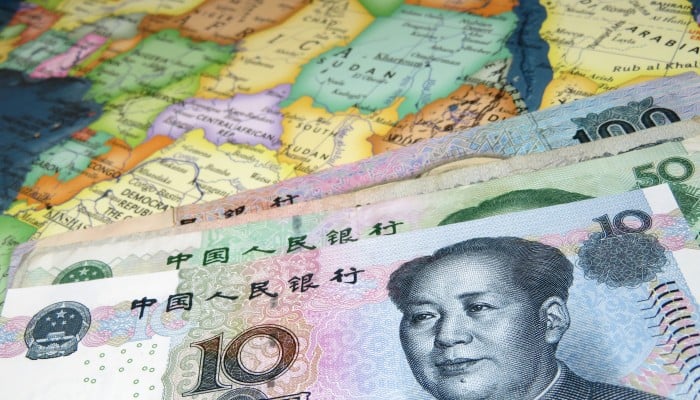
Earlier this month, Angola’s central bank elevated the yuan by allowing commercial banks to use it to meet mandatory foreign currency reserve requirements, placing it alongside the U.S. dollar, the euro and the South African rand.
Days later, Angola’s finance ministry disclosed plans to explore yuan-denominated borrowing to access cheaper financing.
DON’T MISS THIS: Here are ways China is expanding the Yuan’s footprint in Africa to reduce dollar dependence
BFA’s planned entry into CIPS now completes another piece of that broader strategy.
A continent-wide trend
Angola is far from alone. South Africa’s Standard Bank became the first African lender to connect directly to CIPS in late 2025.
Last month, China’s central bank authorised Standard Bank and the Industrial and Commercial Bank of China (ICBC) to jointly provide renminbi clearing services across 19 African countries, making it easier for businesses to settle trade directly in yuan.
Elsewhere, several African countries have expanded currency swap arrangements, encouraged yuan financing and increased the use of China’s currency in bilateral trade as economic links with Beijing deepen.
The trend has accelerated alongside China’s growing role as the continent’s biggest trading partner and infrastructure financier.
More than an alternative to SWIFT
Launched in 2015, CIPS is China’s cross-border payment infrastructure for settling international transactions in yuan.
DON’T MISS THIS: South African bank becomes first African bank to plug into China’s cross-border payment system
Although it remains significantly smaller than the Belgium-based SWIFT messaging network that underpins most global financial transactions, CIPS has expanded steadily as Beijing seeks to internationalise its currency and reduce dependence on dollar-based payment systems.
For African banks, joining CIPS can lower transaction costs, shorten settlement times and reduce the need to convert local currencies into dollars before paying Chinese suppliers.
The dollar still dominates for now
Despite the growing role of the yuan, the U.S. dollar remains the world’s dominant reserve and trade currency, accounting for the majority of international reserves and cross-border transactions.
Even so, analysts say the growing adoption of yuan settlement across Africa is less about replacing the dollar than reflecting the continent’s changing trade patterns.
As China buys more African commodities, finances more infrastructure and expands market access for African exports, banks are increasingly building the financial infrastructure needed to support those relationships.
BFA’s planned integration into CIPS is therefore more than a banking upgrade. It is another sign that Africa’s financial system is gradually adapting to an economic landscape in which China is becoming an increasingly central trading and investment partner.