







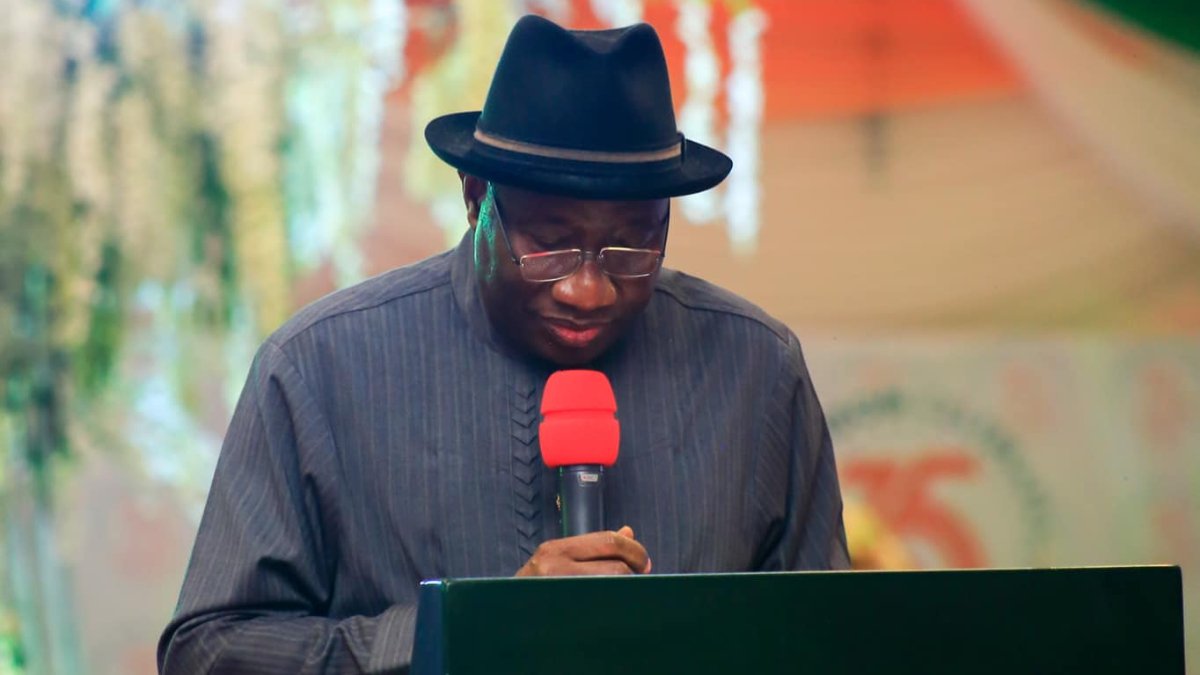
![Ex-President Goodluck Ebele Jonathan. [Facebook]](https://ocdn.eu/pulscms/MDA_/15fec2ab9343bf206edd5b9afcfa248f.jpg)
The former president of Nigeria, Goodluck Ebele Jonathan, recently relayed that the country’s local content strategy for the oil and gas industry was inspired by China’s success in developing a robust domestic petroleum industry.
- Former Nigerian president Goodluck Jonathan revealed that the country’s oil and gas local content strategy was inspired by China’s petroleum industry.
- He noted this at the SweetCrude Dialogue 2026, reflecting on the progress since the Nigerian Oil and Gas Industry Content Development Bill passed in 2010.
- Jonathan’s visit to China influenced his decision after observing the country’s reliance on locally manufactured equipment and technology in its oil sector.
- Local participation in Nigeria’s oil industry has grown from under 5% in 2010 to 61% by 2026, thanks to focused initiatives and training.
The former president made this known at the SweetCrude Dialogue 2026, which was hosted at the Nigerian Content Tower in Yenagoa, Bayelsa State, his hometown, on the passing of the Nigerian Oil and Gas Industry Content Development Bill in 2010 and the progress achieved since its implementation.
During the event, he explained that the initiative came after he visited China while serving as Bayelsa State’s deputy governor.
DON’T MISS THIS: VIDEO: Ex-Nigerian president makes safe return after being trapped in Guinea-Bissau coup
During his China tour, he noticed that almost every part of the Asian country’s oil sector was dependent on locally manufactured equipment, technology, and experience.
He also disclosed that China’s petroleum sector was altered by the discovery of the Daqing Oilfield in 1959, just a few years after crude oil was discovered in Oloibiri, Bayelsa State.
“Almost everything used in the Chinese oil industry was sourced locally,” he disclosed, as seen in the Punch Newspaper.
The discrepancy between the two nations, he said, highlighted concerns about why Nigeria remained so reliant on imported technology, apparatus, and foreign expertise despite its lengthy history of oil production.
The former president stated that these views affected his decision to sign the local content legislation into law in April 2010.
Jonathan revealed that the program has subsequently strengthened the sector by encouraging increased Nigerian involvement and promoting economic growth.
Representing the Executive Secretary of the Nigerian Content Development and Monitoring Board (NCDMB), Felix Ogbe, Director of Monitoring and Evaluation, Esueme Kikile, stated that local content involvement has increased from less than 5% in 2010 to 61% by 2026.
He attributed the development to activities aimed at developing local competence, such as graduate training programs, professional certifications, and infrastructural expenditures.
Projects such as the Nigerian Content Tower, the Oloibiri Museum and Research Centre, the Nigerian Oil and Gas Park Scheme, and gas development projects in Bayelsa were identified as critical contributors to increasing local capacity and maintaining more industrial value in Nigeria.