





![Coal India is evaluating bauxite opportunities in Ghana as it expands beyond its traditional coal business.[moneycontrol]](https://ocdn.eu/pulscms/MDA_/519412860d7dff887226623b6ce3497f.webp)
Coal India, the world’s largest coal producer, is evaluating bauxite opportunities in Ghana as the Indian state-controlled company searches for mineral assets outside its traditional coal business.
- Coal India is evaluating bauxite opportunities in Ghana as it expands beyond its traditional coal business.
- The Indian state-controlled company is also planning its first overseas trading office in Singapore.
- Ghana has about 920 million tonnes of bauxite but does not currently refine its production into alumina locally.
- No Ghanaian asset, negotiation or proposed investment involving Coal India has been confirmed.
The interest forms part of a wider plan to establish Coal India’s first overseas trading office in Singapore, which would support mineral trading and possible acquisitions in Africa and other regions.
Reuters reported on Thursday, citing people familiar with the plans, that the company had started the process of registering the Singapore office.
The proposed hub would examine opportunities involving iron ore, lithium, bauxite, rare earths and other minerals. Coal India is also evaluating assets in Chile, Canada and Australia.
The Ghanaian interest remains preliminary. No particular mine, deposit or company has been identified, while there is no public evidence that Coal India has begun negotiations with Ghanaian authorities.
Coal India looks beyond its traditional business
Coal India produced 768.19 million tonnes of coal during its 2025/26 financial year, according to the company’s official figures.
DON’T MISS THIS: Ghana Bauxite Company targets 6 million tonnes by 2025 with $123 million investment
The company was valued at approximately $26 billion (₹2.48 trillion) on the Indian stock market on 20 August.
It recently secured an iron ore block in India’s Odisha state, marking another step in its expansion beyond coal. Its proposed Singapore office would give it an international base for assessing mineral assets, conducting trades and building relationships with resource owners.
The plan also supports India’s efforts to secure minerals needed for manufacturing, renewable energy, electric vehicles and defence.
India approved its National Critical Mineral Mission in January 2025. The programme covers domestic exploration, processing, recycling and the acquisition of mineral assets abroad.
India’s most significant overseas success under the strategy has been an agreement to explore five lithium blocks covering 15,703 hectares in Argentina.
Why Ghana is on Coal India’s radar
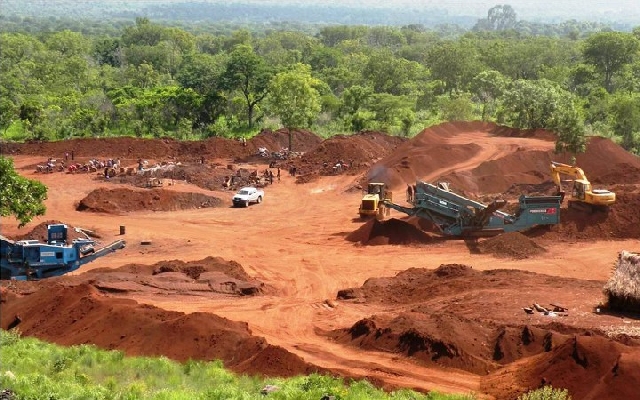
Ghana has an estimated 920 million tonnes of bauxite, principally located in Awaso, Nyinahin and Kyebi, according to the state-owned Ghana Integrated Aluminium Development Corporation.
However, Ghana does not currently have an operating refinery that converts locally mined bauxite into alumina.
The Awaso mine produces approximately one million tonnes of bauxite annually. The material is exported, while the state-owned Volta Aluminium Company imports the alumina needed for its smelting operations.
GIADEC wants to increase production at Awaso to five million tonnes annually and construct a refinery with capacity to produce approximately 1.6 million tonnes of alumina a year.
It is also working with Ghanaian mining company Rocksure International on a planned mine and refinery at Nyinahin-Mpasaaso.
DON’T MISS THIS: Africa’s largest bauxite producer cancels 46 mining licenses amid sector reform
Metlen Energy & Metals, formerly Mytilineos, is involved in a separate project covering an estimated 300 million tonnes of bauxite. That project could eventually produce up to 10 million tonnes annually and support another alumina refinery.
Any Coal India investment would therefore have to fit into Ghana’s existing plan for four mines, at least two refineries and an expanded aluminium-smelting industry.
GIADEC is required to retain at least a 30 per cent interest in any new joint venture within the integrated aluminium industry.
This creates a central question for any prospective Indian involvement. Ghana is seeking investment that will help it process bauxite locally, rather than continue exporting the raw material.
Coal India’s interest could provide another source of capital for the industry. However, it is not yet known whether the company wants a mining asset, a stake in an existing project or access to future bauxite production.
Until those details emerge, the development should be presented as an evaluation, not a planned acquisition or confirmed investment.