






![Senegal jails TikTok influencers amid Faye-Sonko political tensions.[Gemini Generated Image]](https://ocdn.eu/pulscms/MDA_/0266821c8973ce03f31b281633cd9600.png)
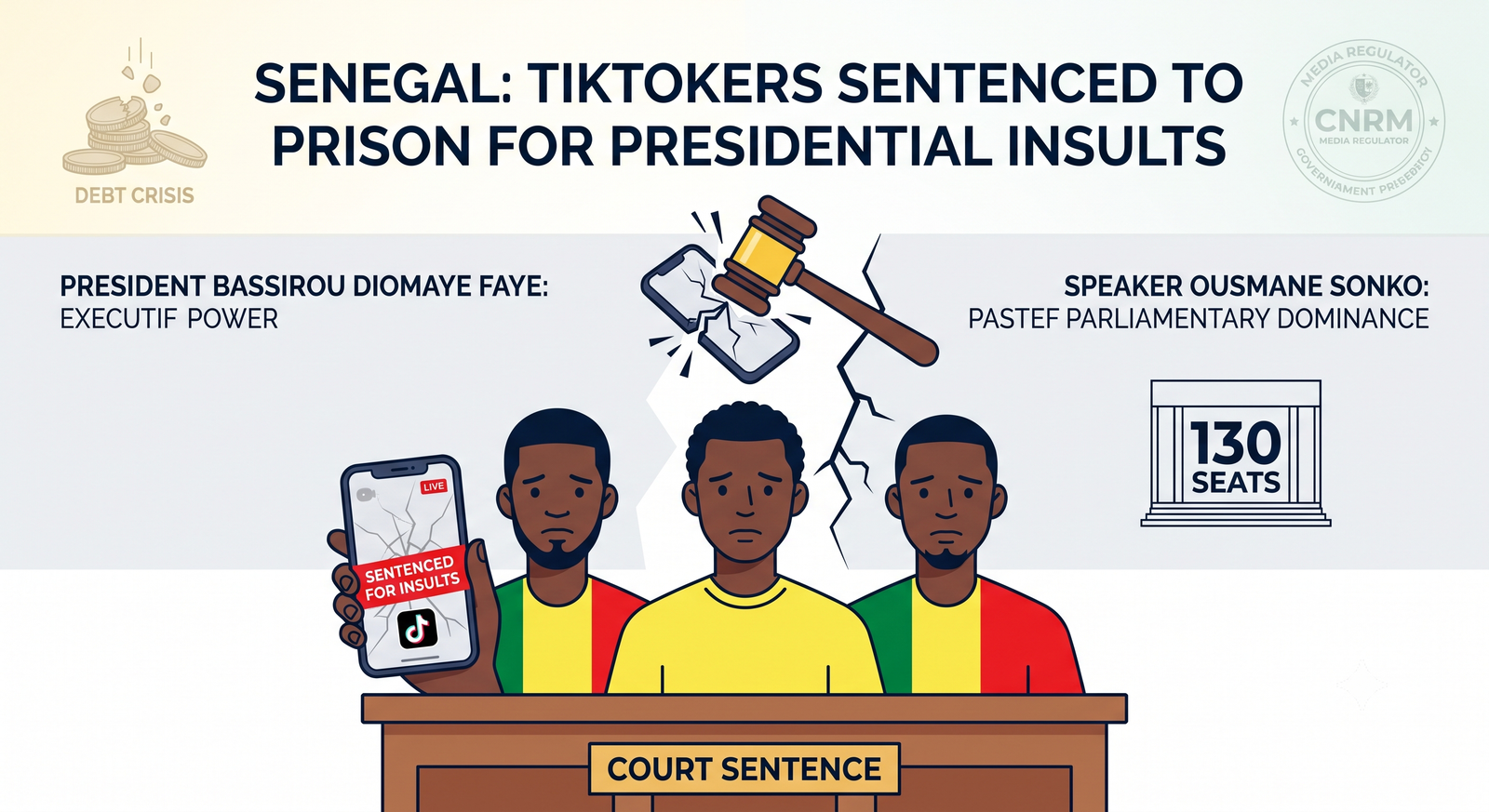
A Senegalese court has sentenced three TikTok influencers to prison for insulting President Bassirou Diomaye Faye, putting the country’s increasingly influential online political space under scrutiny at a time of heightened tensions within its ruling establishment.
- Senegal has jailed three TikTok influencers for insulting President Bassirou Diomaye Faye.
- The case comes as Faye’s relationship with former ally Ousmane Sonko has sharply deteriorated.
- It also raises fresh concerns over online speech and political expression in Senegal.
- The convictions come as Faye faces pressure to tackle the country’s growing debt crisis.
The three content creators, who are associated with digital platform Feenal Digital, were convicted on Thursday over videos posted about Faye, Reuters reported, citing their lawyer.
Magueye Diaw, popularly known as Oustaz Thiep, and Moustapha Ndiaye, known as Ndiaye Touba, were sentenced to two months in prison without parole and fined CFA500,000 ($890) each. A third contributor to the platform was also convicted.
Their lawyer, Abdy Nar Ndiaye, argued that the videos were comedic and should not have resulted in criminal prosecution.
The convictions would ordinarily amount to a relatively contained dispute over the limits of political commentary.
But they come at an unusually sensitive moment for Senegal, where a dramatic breakdown in relations between Faye and the political movement that propelled him into the presidency has created competing centres of power.
DON’T MISS THIS: Senegal appoints economist PM as $13 billion debt crisis deepens pressure on Faye’s govt
Feenal Digital has published content regarded as sympathetic to the African Patriots of Senegal for Work, Ethics and Fraternity, better known as PASTEF, the party led by former Prime Minister Ousmane Sonko.
That connection adds a political dimension to the case, although there is no evidence that the influencers were prosecuted because of their perceived political sympathies.
From political partners to rivals
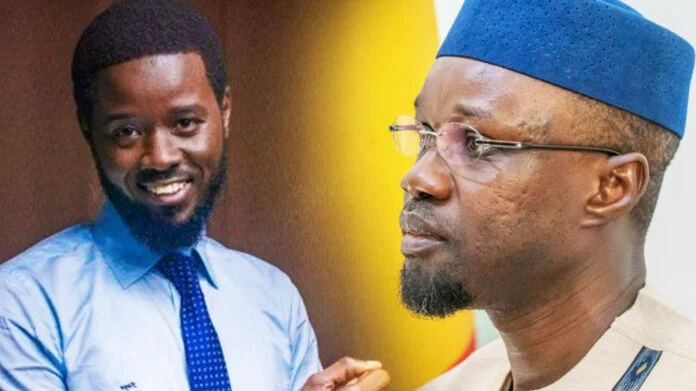
Faye’s presidency is inseparable from Sonko’s political rise.
Sonko was the dominant opposition figure ahead of Senegal’s 2024 presidential election but was prevented from standing. Faye, then relatively unknown outside Senegal, contested in his place with Sonko’s backing and won the presidency.
Faye subsequently appointed Sonko prime minister, creating an unusual political arrangement in which the president formally held executive power while his former political mentor retained enormous influence within PASTEF and among the movement’s supporters.
That alliance eventually fractured. Differences over economic policy and, crucially, how Senegal should handle its mounting debt crisis contributed to the rupture.
Faye dismissed Sonko as prime minister in May and dissolved his government. Sonko, however, quickly returned to a powerful institutional position as speaker of Senegal’s parliament.
DON’T MISS THIS: Faye and Sonko Split: Senegalese politics shaken amid leadership clash and debt crisis
The development means Faye now governs alongside a former ally who retains significant control over the country’s political machinery.
PASTEF holds 130 of the 165 seats in Senegal’s National Assembly, leaving Sonko with a formidable parliamentary base even after his removal from government.
Analysts have described the rupture as creating two competing centres of political power at a particularly difficult moment for Senegal. Carnegie Endowment noted that their differences included the government’s approach to negotiations with the International Monetary Fund and the possibility of restructuring the country’s debt.
Senegal’s social media question
The TikTok convictions also reopen a wider debate over the limits placed on online expression in one of West Africa’s most closely watched democracies.
Senegal already has legislation extending offences committed through public communication to digital channels. Its 2008 cybercrime law explicitly recognises digital electronic communication as a means of public dissemination.
The regulatory environment has expanded further.
In April, Senegal promulgated legislation creating the National Council for Media Regulation, or CNRM, with authority extending beyond traditional newspapers and broadcasters to online media, digital platforms and content creators. The regulator can impose sanctions and other measures under the new framework.
That makes the imprisonment of TikTok personalities significant beyond the personalities themselves: Senegal is confronting the same question facing governments across Africa as political conversations migrate from newspapers and television stations to creators capable of reaching large audiences directly through smartphones.
DON’T MISS THIS: Senegal cracks down on foreign trips for ministers as global oil prices surge
The country’s relationship with TikTok has already been politically contentious. Senegalese authorities suspended the platform during unrest in 2023, when Sonko was still an opposition leader, saying it was being used to distribute messages that threatened stability.
![Ousmane Sonko remains one of Senegal’s most powerful political figures after becoming parliamentary speaker following his dismissal as prime minister.[Photo by Abdel Majid BZIOUAT / AFP via Getty Images]](https://ocdn.eu/pulscms/MDA_/104d7ebb5510d4d350a42070eb62b901.jpg)
Political tensions meet an economic crisis
The latest controversy also lands as Faye faces a much larger challenge- stabilising Senegal’s finances.
The country has been struggling with the consequences of billions of dollars in previously undisclosed borrowing accumulated under former President Macky Sall.
The revelation sent Senegal’s debt burden sharply higher, triggered sovereign credit-rating downgrades and disrupted its relationship with the IMF. Reuters reported in June that the debt crisis had left the government attempting to restore investor confidence and reach an understanding with the Fund.
DON’T MISS THIS: Prime Minister of Senegal considers expelling French troops from national territory
The African Development Bank this week approved a $35.4 million financing package to strengthen Senegal’s public financial management, another indication of the pressure on Dakar to improve fiscal governance while dealing with the debt problem.
The debt question also helped drive Faye and Sonko apart.
Sonko had strongly resisted restructuring Senegal’s debt, while Faye moved towards greater engagement with international creditors. Senegal has subsequently signalled that restructuring could be considered if necessary.
That makes the political environment surrounding the TikTok case particularly delicate.
Less than three years after Faye and Sonko stood together as symbols of political change in Senegal, the former allies now occupy rival centres of power, while a digital ecosystem that helped amplify anti-establishment politics is itself facing growing legal and regulatory scrutiny.
For Faye, the challenge is therefore no longer simply managing Senegal’s economic crisis. His government must also navigate the political movement that brought him to power — and an online audience capable of taking that increasingly public dispute far beyond parliament.