







A possible new gold discovery stretching six kilometres has emerged in Namibia, with a Canadian-listed miner preparing its first major drilling campaign after fresh exploration results strengthened evidence of a substantial mineralised system beneath the surface.
- Namibia’s Ongwe Minerals has identified a six-kilometre gold anomaly at its Nguni prospect.
- The company plans a 5,000-metre drilling campaign to test the discovery underground.
- Exploration results found gold levels reaching 1,310ppb, with the anomaly still open in three directions.
- A successful discovery could strengthen Namibia’s growing gold sector and reduce reliance on diamonds.
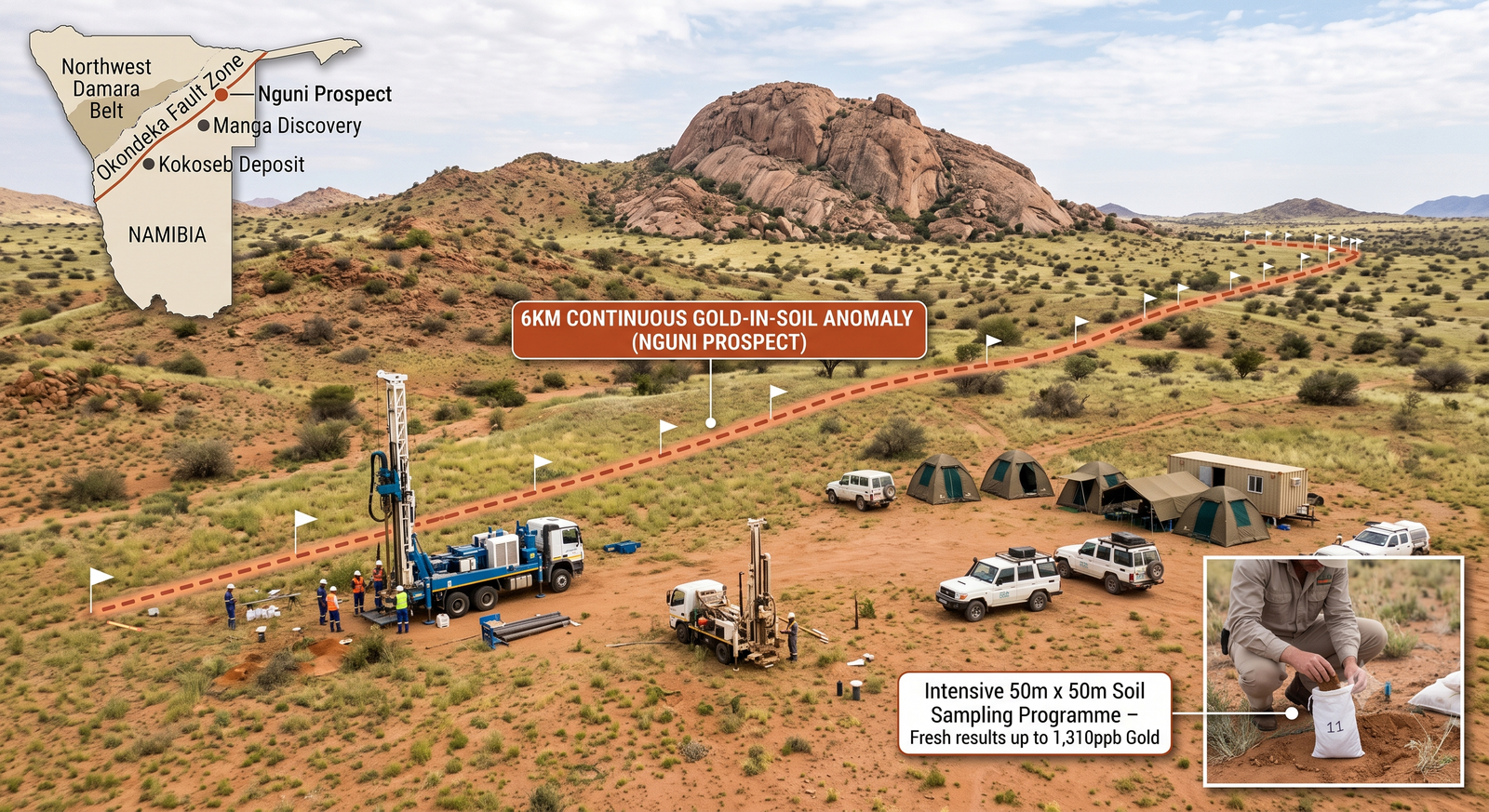
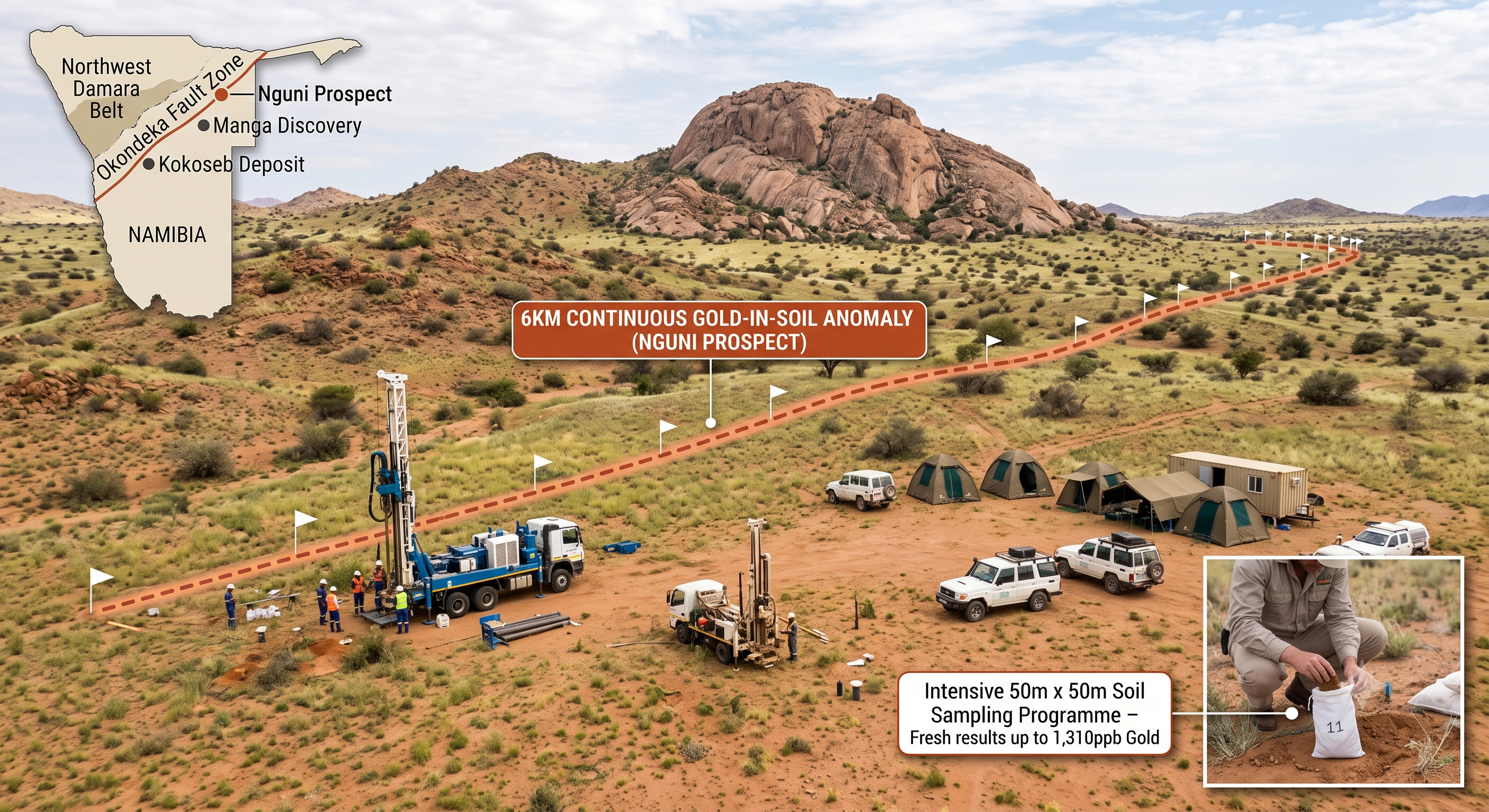
Ongwe Minerals said its newly discovered Nguni prospect has now produced a continuous six-kilometre gold-in-soil anomaly, up from the more than five kilometres initially identified when the company announced the discovery in June.
Fresh results from an intensive soil sampling programme returned 50 samples containing more than 300 parts per billion of gold, with the strongest assay reaching 1,310ppb.
The company will now begin a maiden 5,000-metre diamond drilling programme in August, alongside reverse-circulation drilling, in what will be the first significant test of whether the extensive surface anomaly continues underground.
Nguni is part of Ongwe’s Omatjete Gold Project and was discovered only in May during a regional exploration programme targeting the Okondeka Fault Zone, a structure that is becoming increasingly important in Namibia’s emerging gold exploration industry.
Ongwe’s latest results significantly expand what was known about the prospect two months ago.
When Nguni was first announced in June, Ongwe had defined a gold anomaly extending more than five kilometres and reported samples reaching 730ppb.
Following a much denser 50-metre-by-50-metre sampling programme involving 1,605 samples, the company has now established a continuous six-kilometre footprint above 50ppb, with its strongest result almost twice the peak recorded during the initial exploration programme.
Potentially more significant is what Ongwe has not yet been able to sample.
The gold anomaly remains open to the north, east and west, meaning its full dimensions have yet to be established.
DON’T MISS THIS:Canadian miner Montage Gold fast-tracks second Côte d’Ivoire mine as Africa’s newest gold hotspot attracts billions
Ongwe is completing access agreements covering neighbouring farms in those directions, which could allow exploration teams to determine whether Nguni extends beyond its existing six-kilometre footprint.
Some of the strongest results are also emerging close to the current boundaries of the sampling grid.
In the northern section, the company identified a small leucogranite intrusion using radiometric data, which it believes may form an important part of the mineralising system.
To the southeast, another cluster of rising gold grades approaches a prominent magnetic feature located along a leucogranite contact.
Both areas have now been identified as priority exploration targets. The significance of Nguni goes beyond its size.
It sits within an emerging gold corridor where explorers have made a series of increasingly substantial discoveries despite large areas being hidden under calcrete, sand and other surface cover.
Nguni is approximately 17 kilometres from Ongwe’s Manga gold discovery and about 55 kilometres east of Wia Gold’s Kokoseb deposit.
Ongwe says the geological architecture at Nguni resembles Kokoseb, with gold mineralisation concentrated in metasedimentary rocks close to granitic contacts.
Kokoseb provides an important benchmark for why the company is aggressively advancing Nguni.
According to figures cited in Ongwe’s August update, the Kokoseb resource had grown by July to 54.2 million tonnes grading 1.04 grams per tonne in the indicated category and a further 35 million tonnes at 0.99 grams per tonne in the inferred category.
That does not mean Nguni will ultimately become another Kokoseb.
Nguni remains at a much earlier exploration stage and has not yet produced drill results or a mineral resource estimate. Soil samples indicate the presence and distribution of gold close to the surface, but cannot determine the quantity or economic viability of gold underground.
Ongwe chief executive Dave Underwood said the company intends to begin with a single drilling rig and increase the programme as its geological understanding improves.
The company plans to use both reverse-circulation and diamond drilling to establish the structure beneath an area where natural rock exposure is limited.
Surface mapping shows much of Nguni is hidden under between one and five metres of alluvial material, leaving only limited schist and granite exposed along river cuttings. Ongwe believes most of the gold anomaly is nevertheless situated close to its original source rather than having been substantially transported by surface drainage.
![Namibia is attracting growing gold exploration as projects including Nguni, Kokoseb and the US$475 million Twin Hills development expand the country’s mining pipeline. [Photo by Amy Nip/South China Morning Post via Getty Images]](https://ocdn.eu/pulscms/MDA_/6f60e9cce8c768d007ba494f5758307c.jpg)
The discovery is part of a much wider exploration push by Ongwe across Namibia’s Northwest Damara Belt.
Earlier this year, the company expanded its Omatjete land position by as much as 42% and said it controlled approximately 50 kilometres of strike along the Okondeka Fault Zone, which hosts Kokoseb as well as its own Manga prospect.
Ongwe is also exploring its Khorixas project, where the Belmont prospect has a surface footprint measuring about 12 by six kilometres.
The wider region remains comparatively underexplored because extensive calcrete and wind-blown sand have concealed large portions of the underlying geology, making modern geochemical and geophysical exploration increasingly important.
DON’T MISS THIS:Namibia taps Ghana’s gold model to fortify national economy
The surge in exploration comes as gold is taking on greater economic importance in a Namibian mining industry historically dominated by diamonds and uranium.
Namibia’s Chamber of Mines said gold mining operations generated the majority of fiscal revenue reported by its members in 2025, supported by strong production and record international gold prices.
Total taxes paid by Chamber members rose 39% to N$7.81 billion during the year, with the financial performance of B2Gold and the Navachab Gold Mine among the main drivers.
The government expects the shift to continue.
Corporate income tax from non-diamond mining is projected to climb 54%, from N$2.89 billion in the 2024/25 financial year to N$4.44 billion in 2025/26, reflecting stronger contributions from gold, uranium and base metals.
The Chamber said the figures point to an evolution in Namibia’s mining revenue base as gold and uranium increasingly complement diamonds as major contributors to state revenue.
There is also more gold capacity under construction.
China-owned Osino Resources is developing the US$475 million Twin Hills project, described by the company as Namibia’s third and newest gold mine.
Twin Hills contains more than two million ounces of gold reserves and is designed to produce an average of about 162,000 ounces annually during a 13-year mine life. Construction is underway, with the project expected to create roughly 1,000 jobs during construction and about 800 during operations.
DON’T MISS THIS:Namibia’s diamond revenues overtaken by other minerals after price plunge
The discovery history at Twin Hills also illustrates how quickly Namibia’s concealed gold systems can move from early exploration to major projects.
Osino discovered Twin Hills in 2019 after exploring areas largely concealed beneath calcrete and sand. Years of drilling subsequently transformed it into a multimillion-ounce development now moving towards production.
Ongwe is effectively betting that the same exploration model can uncover additional deposits elsewhere along Namibia’s prospective fault systems.
At Nguni, it now has a six-kilometre surface anomaly, gold values reaching 1,310ppb, geological similarities to a nearby multi-million-ounce deposit and unexplored extensions in three directions.