







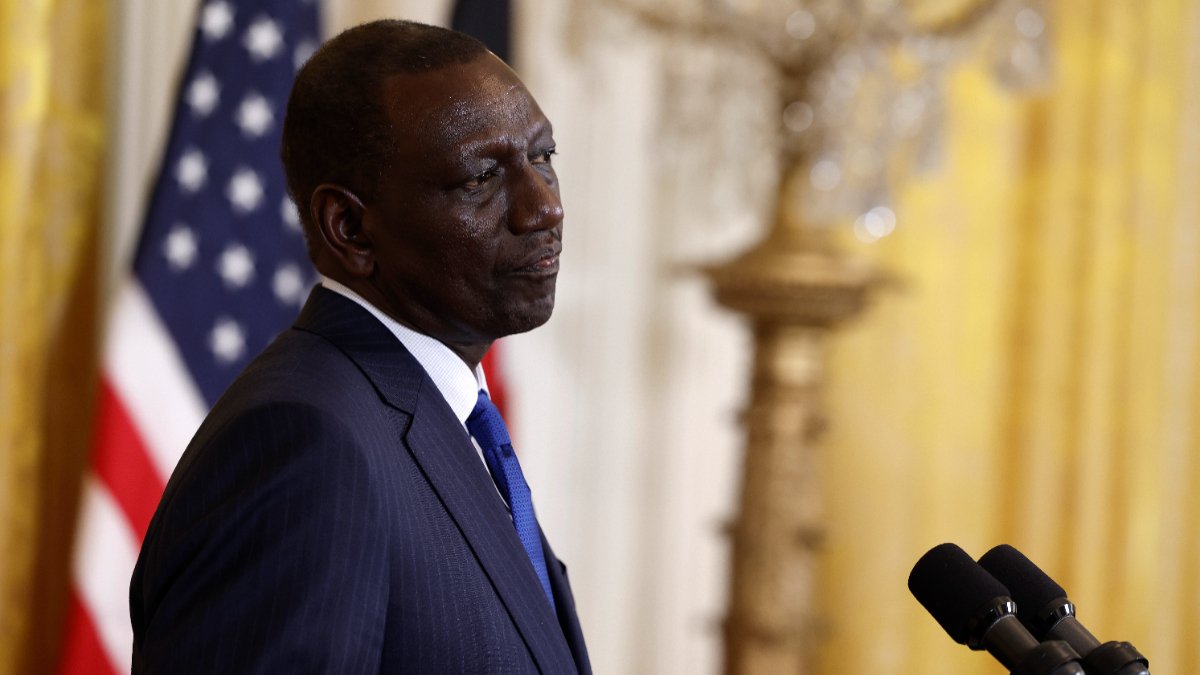
![Kenya reverts to lower-quality fuel owing to a conflict on another continent [Photo by Anna Moneymaker/Getty Images]](https://ocdn.eu/pulscms/MDA_/05d8b1aead7fb19f1050255b1d051672.jpg)
As access to refined fuel continues to be hampered by the Iranian war, one of Africa’s largest economies, Kenya, has temporarily modified its fuel quality criteria.
- Kenya has temporarily relaxed its fuel sulfur limits due to supply disruptions caused by instability in the Middle East.
- The Ministry of Investments, Trade, and Industry authorized a six-month waiver, allowing sulfur content up to 50mg/kg in gasoline and diesel.
- The decision was made after consulting the Kenya Bureau of Standards, the National Standards Council, and the Ministry of Energy and Petroleum.
- Authorities say the move aims to prevent fuel shortages that could disrupt business operations.
Under the direction of Lee Kinyanjui, the nation’s Ministry of Investments, Trade, and Industry authorized a six-month waiver for increased sulfur levels in gasoline and diesel.
DON’T MISS THIS: Kenya’s fuel retailers are running low on supply, and it could become a total crisis
The temporary policy essentially allows the country to return to previous levels before the adoption of stronger environmental regulations, with the sulfur limit set at a maximum of 50 milligrams per kilogram.
The National Standards Council, the Kenya Bureau of Standards, and the Ministry of Energy and Petroleum were consulted before the decision was made, as seen on Tuko.
According to authorities, the action is intended to avoid fuel shortages that would impede business operations.
What the Kenyan ministry said
A statement seen on the country’s Ministry of Investment, Trade, and Industry’s X account reads, “Upon review by our technical team, and following consultations with the Kenya Bureau of Standards, and the National Standards Council, the ministry has subjected the request to a comprehensive technical assessment.”

Concerning the new parameters, it adds “It is against this backdrop and in full consideration of the need to safeguard the welfare of Kenyan consumers and the stability of the economy, that the Ministry of Investment, Trade and Industry has approved a request by the Ministry of Energy and Petroleum under the guidance of the National Standard Council to temporarily waive the sulphur parameter, to the maximum limit of 50mg/kg.”
The continued instability in the Middle East is at the heart of the problem, as it has had a huge impact on global oil supply systems.
The Strait of Hormuz, in particular, a crucial route for a huge portion of the world’s oil shipments, has been disrupted, making it more challenging for Kenya and several other African nations, dependent on fuel imports, to obtain fuel that fits their newer, tighter criteria.
Officials observed that during the crisis, suppliers struggled to acquire standard fuel, prompting urgent calls from industry stakeholders.
After a technical examination, the government decided on a temporary relaxation to ensure consistent availability at petrol stations across the country.
While the alteration is intended to stabilize supply in the short term, there are trade-offs.
Higher sulphur content in fuel is linked to increased emissions, prompting worries about air quality and potential health consequences.
Kenya had previously moved toward cleaner fuel regulations to align with larger regional and global environmental goals.