







Nigeria’s oil industry is entering a new phase. The country’s biggest challenge is no longer a lack of refining capacity but producing enough crude oil to supply its refineries.
- Nigeria’s oil sector now faces the challenge of producing enough crude to supply its domestic refineries.
- The Dangote Petroleum Refinery alone requires 552,500 barrels per day, about 35% of Nigeria’s daily oil output.
- After meeting Dangote’s needs, only 1.01 million barrels per day remain for other uses, leaving little margin for disruptions.
- Fuel prices in Nigeria are now more sensitive to production costs and exchange rate changes due to market deregulation.
As domestic refining expands, Nigeria must balance crude supplies for local processors, export commitments, and crude-backed loan agreements.
Math behind the crude oil deficit
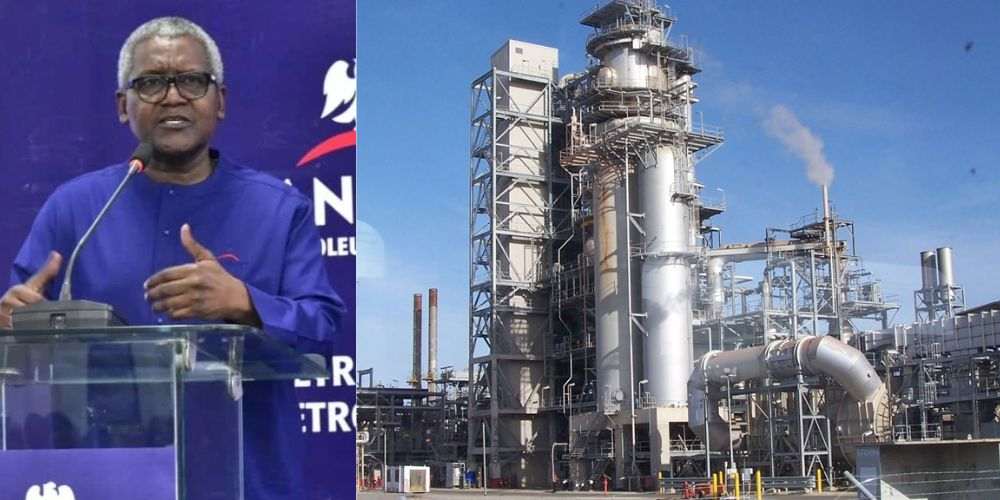
At an estimated 85% operating capacity, the Dangote Petroleum Refinery needs about 552,500 barrels of crude oil per day. That is roughly 35% of Nigeria’s total daily crude production.
DON’T MISS THIS: Heirs of Africa’s richest billionaire back plan to donate one-third of his $36.5 billion fortune to charity
Nigeria produced 1.56 million barrels per day in June. After supplying the Dangote refinery, about 1.01 million barrels per day remains for smaller domestic refineries, export commitments, and crude-backed financing deals.
While that is enough under normal conditions, it leaves little room for unexpected disruptions such as pipeline failures, production outages, or security incidents in the Niger Delta.
According to Punch, records from May and June 2026 show that the Dangote refinery sourced only 78% of its crude oil supply from the Nigerian National Petroleum Company (NNPC). The remaining 22% was imported from other countries.
Pressure on local crude oil refiners
Nigeria’s challenge is not a shortage of oil reserves. The country holds an estimated 37.28 billion barrels of crude oil and condensate. The immediate issue is producing enough oil each day to meet rising demand.
DON’T MISS THIS: Heirs of Africa’s richest billionaire back plan to donate one-third of his $36.5 billion fortune to charity
With Nigeria’s downstream fuel market largely deregulated, fuel prices are now more closely tied to production costs and exchange rate movements.
As a result, any disruption in crude supply can quickly push up pump prices.
A report by Lagos-based research firm PAC Research, cited by BusinessDay, said:
“with domestic refining capacity expanding, the sector’s performance will increasingly depend on whether upstream production can meet three competing demands: refinery feedstock, export obligations and crude-backed financing commitments.“
![A general view of Dangote Petroleum Refinery Petrochemicals in Lagos, on May 22, 2023. Nigerian President Muhammadu Buhari has inaugurated Dangote Petroleum Refinery and Petrochemicals, the largest single-train refinery in the world with 650,000 barrels per day refining capacity. [Photo by PIUS UTOMI EKPEI/AFP via Getty Images]](https://ocdn.eu/pulscms/MDA_/852917205edbaca51dc9b9f9ee90a000.jpg)
The firm added that the interaction between these structural pressures will shape fuel pricing, foreign exchange demand, inflation, and investor confidence over the next 12 to 18 months.
DON’T MISS THIS: World’s largest single-train refinery reveals why it abandoned its U.S. dollar petrol sales policy
Speaking to BusinessDay, energy analyst Aisha Mohammed of the Lagos-based Centre for Development Studies said
“the deeper issue is domestic, and it isn’t going away: Nigeria simply doesn’t pump enough oil to satisfy its own refining ambitions, let alone its export contracts and crude-backed financing deals.“
Three reported reasons why the crude oil shortage persists
According to industry data from Petroleumprice.ng, a major obstacle is that the NNPC pledged roughly 272,500 barrels per day to service over $8.8 billion in oil-backed loan obligations.
Because these debt commitments take priority, the state oil firm lacks sufficient free crude to fulfill its Naira-denominated sales allocations to local processors.
As reported by Punch Newspapers, persistent upstream operational bottlenecks, including widespread oil theft, pipeline outages, and chronic underinvestment in field infrastructure, continue to cap national daily production.
These output constraints make it difficult for the NNPC to meet domestic refinery demand while simultaneously fulfilling its international export contracts.
As detailed by Business Post Nigeria, local facilities such as the Dangote Refinery regularly receive far less crude than promised under the Naira arrangement.
Consequently, processors are forced to import foreign feedstock or purchase Nigerian oil in U.S. Dollars through third-party traders.
Purchasing crude in dollars drives up processing costs, inflates local fuel prices, and has prompted Dangote refinery to pursue direct upstream production to secure its own supply.