





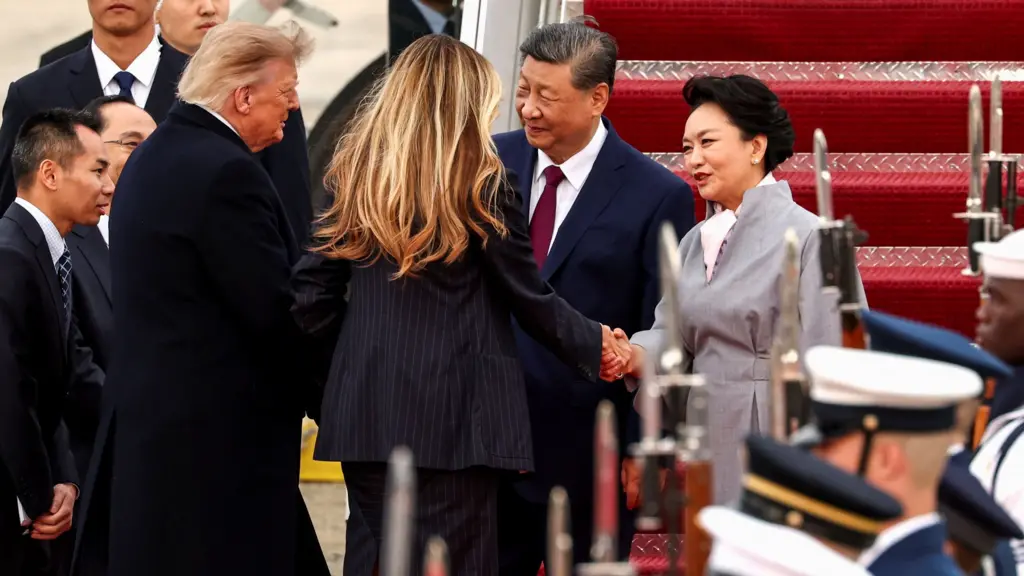
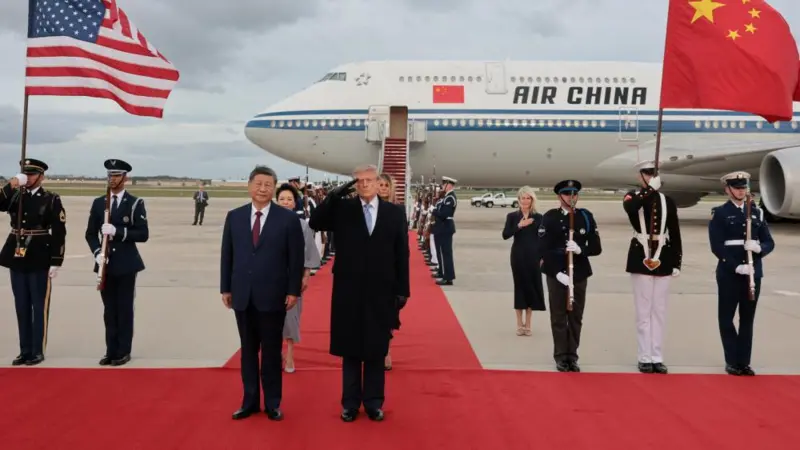
![Two of the world’s most powerful presidents, Donald Trump of the US and Xi Jinping of China, meet as leaders with sharply different approaches to Africa discuss global issues [Image Credit: BBC]](https://ocdn.eu/pulscms/MDA_/e3a181b377c24283bc2254b6d5689ba6.png)
U.S. President Donald Trump greeted Chinese President Xi Jinping at Joint Base Andrews with a formal red-carpet arrival to open a three-day summit in Washington.
- President Donald Trump welcomed Chinese President Xi Jinping to Washington with a formal red-carpet ceremony.
- The United States and China agreed to extend their trade war truce.
- Xi Jinping emphasized partnership over rivalry, expressing that Chinese and American national goals can benefit the world.
- U.S. imposed 12.5% tariffs on imports from major African exporters, due to concerns over forced labor.
During the initial high-stakes talks, U.S. Treasury Secretary Scott Bessent announced that the two global powers agreed to extend their trade war truce through January 10.
While meeting on the tarmac, Donald Trump hailed Xi Jinping as a “great leader”.
In a written statement delivered upon his arrival, Xi Jinping stated that “the two countries should be partners rather than rivals,” according to Chinese state media reporting.
One key item on the agenda for the three-day summit is critical minerals.
Reuters noted that “Trump has taken a less combative approach than usual ahead of his meeting with Xi because of China’s growing power thanks to the critical minerals issue.”
“China controls up to 70% of global rare-earth mining, 85% of refining capacity, and about 90% of rare-earth metal alloy and magnet production, according to consultancy AlixPartners.“
Other items on the agenda include AI, agricultural products, and the sale of US weapons to Taiwan:
DON’T MISS THIS: U.S., China and UK stay out as South Africa, Canada, Germany and EU join 20 nations uniting to tackle AI dangers
BBC reported that Xi Jinping said that “realising the great rejuvenation of the Chinese nation and making America great again can fully coexist, reinforce each other and benefit the world“.
Despite the trade truce and diplomatic efforts to reduce rivalry and improve economic relations, the two superpowers continue to take sharply contrasting approaches to trade with Africa.
U.S. President Trump imposed tariffs on exports from Nigeria and South Africa
As the two leaders discuss global issues, the United States and China continue to pursue contrasting economic policies across the African continent.
Under President Donald Trump’s Section 301 trade wall, the United States introduced a 12.5% tariff targeting imports from 60 economies.
As reported by Business Insider Africa, major African exporters including Nigeria, South Africa, Egypt, Morocco, Algeria, and Angola fall into this higher tariff category.
According to an official memorandum from the White House, the measures were introduced after an investigation determined that trading partners failed to adequately stop goods produced with “forced labor” from entering supply chains.
DON’T MISS THIS: World’s third most powerful military offers 41 African nations deeper security cooperation to confront two vicious enemies the U.S. has battled for years
President Donald Trump noted that officials evaluated several alternatives but determined tariffs were the most effective means to address unfair trade practices.
China expands zero-tariff access to 53 African nations as U.S. tariffs reshape Africa trade
In contrast to Washington’s new import duties, Beijing has expanded duty-free trade access across almost the entire African continent.
China expanded its zero-tariff policy on May 1 to cover 53 out of 54 African nations. The Southern African nation of Eswatini remains the sole exception because of its ongoing diplomatic ties with Taiwan.
As reported by Business Insider Africa, political scientist Wen-Ti Sung from the Australian National University told explained that China is “weaponizing its ties with African countries and showing how relations with China come with strings attached“.
DON’T MISS THIS: U.S. and China deepen mutual distrust in a race as one of Africa’s largest economies surges ahead of 42 nations including Israel, China and Singapore
Beijing maintains that adherence to the “One China” principle remains a necessary requirement for countries receiving preferential trade access.