





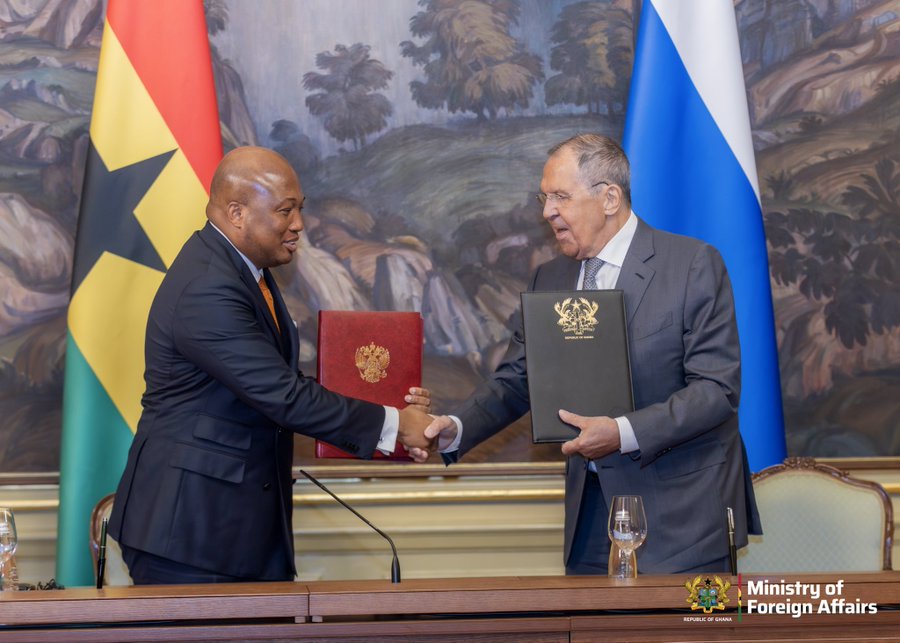
![Delegation from Ghana led by Ghana's Foreign Minister Samuel Okudzeto Ablakwa and Russian Foreign Minister Sergey Lavrov and his team [image X @S OkudzetoAblak]](https://ocdn.eu/pulscms/MDA_/2532cea7665f13837d84e3ba44c98ee7.jpg)
Russia says it is preparing to sign a security cooperation agreement with the Economic Community of West African States, potentially extending Moscow’s influence from its military partners in the Sahel to the region’s main political and economic bloc.
- Russia says it plans to sign a cooperation agreement with ECOWAS covering regional security.
- Moscow has also offered to help rebuild relations between ECOWAS and Mali, Burkina Faso and Niger.
- The proposal comes as Russia increases military support for the three countries through weapons, training and its Africa Corps.
- Russia is separately pursuing closer defence, nuclear energy and commercial ties with Ghana.
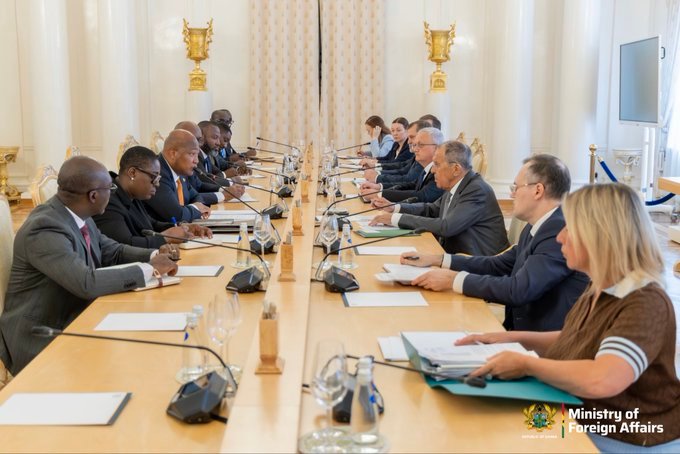
Russian Foreign Minister Sergey Lavrov disclosed the planned agreement in Moscow following talks with Ghana’s Foreign Minister, Samuel Okudzeto Ablakwa.
Lavrov said the proposed memorandum would cover cooperation with ECOWAS, including security, although he did not disclose when it would be signed or what commitments it would contain.
“Russia will sign a memorandum of cooperation with ECOWAS, including in the field of security,” Lavrov said, according to a statement published by the Russian Foreign Ministry.
He added that Moscow was prepared to support efforts to improve relations between ECOWAS and the Alliance of Sahel States, comprising Mali, Burkina Faso and Niger.
There has been no corresponding public announcement from ECOWAS detailing the proposed memorandum. The scope and status of the agreement, therefore, remain based on the Russian government’s account.
If concluded, the agreement would give Russia a formal channel for security engagement with ECOWAS at a time when the bloc is confronting terrorism, political instability and a damaging split with the three Sahel countries.
Russia offers to bridge ECOWAS and the Sahel alliance
Lavrov said Russia was ready to support efforts to “build bridges” between ECOWAS and the three countries that withdrew from the bloc.
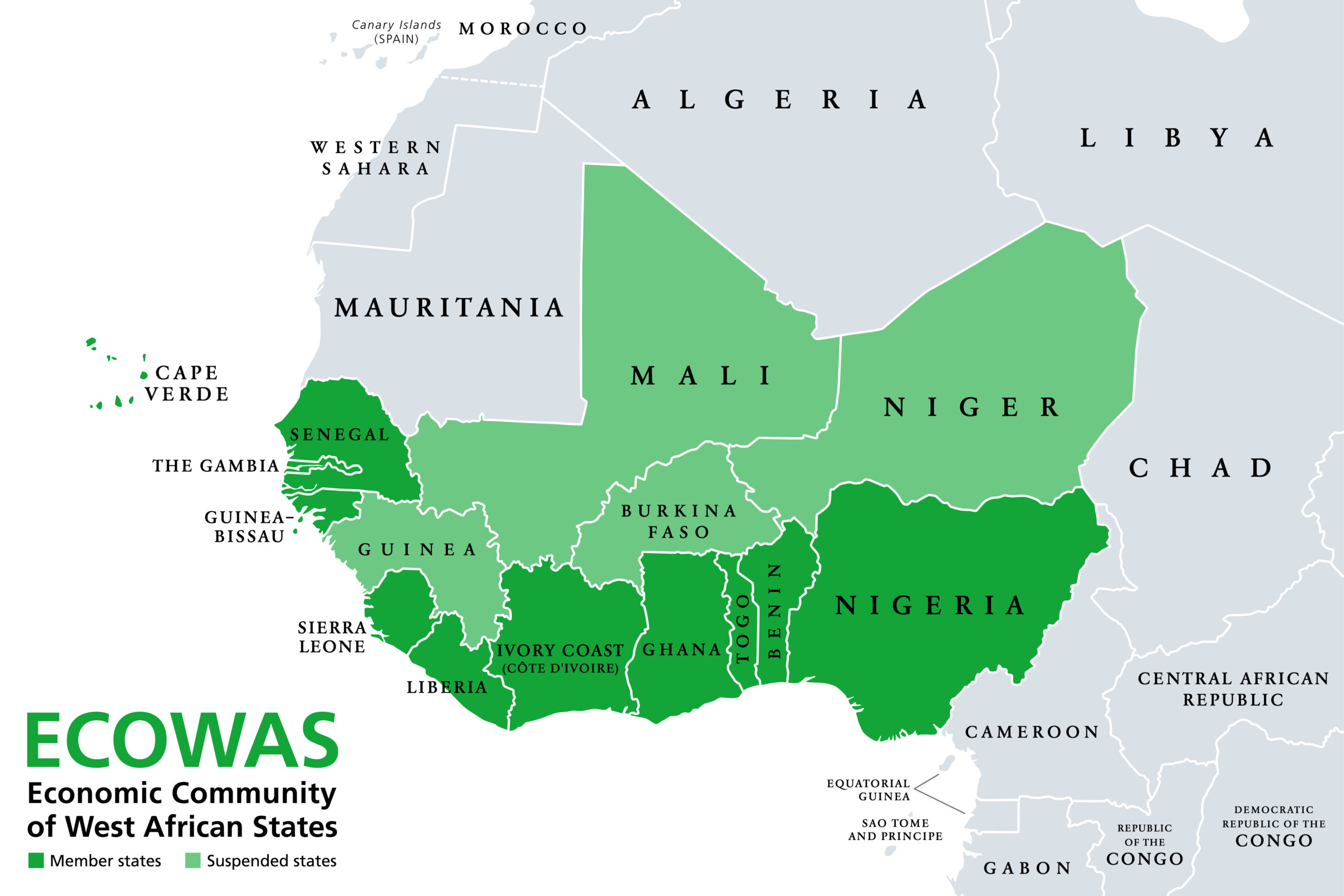
Burkina Faso, Mali and Niger formally ceased to be ECOWAS members on 29 January 2025 after relations deteriorated over military coups, sanctions and demands for a return to constitutional government.
DON’T MISS THIS: Russian weapons and specialists reach breakaway ECOWAS countries
The three countries accused ECOWAS of departing from its founding principles and acting under the influence of foreign powers. They subsequently consolidated the Alliance of Sahel States as a separate political, economic and defence bloc.
Their withdrawal reduced ECOWAS from 15 to 12 member countries and weakened attempts to coordinate security operations across borders used by armed groups.
ECOWAS has kept channels of communication open and temporarily preserved free movement and trade arrangements for citizens and goods from the three states. However, the two blocs have yet to establish a durable framework for political and security cooperation.
Russia’s offer is significant because Moscow is not a neutral outsider in the division. It is one of the closest military partners of the three Sahel governments.
Moscow strengthens military ties with breakaway states
Mali, Burkina Faso and Niger have strengthened relations with Russia after reducing military cooperation with France and other Western governments.
Russia has supplied equipment, training and personnel while pledging support for the Sahel alliance’s joint military force.
In July, Russia and the three countries agreed to deepen military and military-technical cooperation, including assistance from the Russian Africa Corps. Moscow also promised continued support for their armed forces and the alliance’s unified force.
The three countries established the joint force to combat armed groups operating across their borders. Russia had previously pledged equipment and training for the initiative.
This places Moscow in an unusual position. It is seeking a security relationship with ECOWAS while already supporting the separate military structure created by three former members of the bloc.
Lavrov argued that cooperation between the two sides was necessary because insecurity does not stop at political borders.
That concern has become more urgent as armed groups expand their operations beyond the central Sahel. Benin and Togo have experienced attacks in their northern regions, while Ghana and Côte d’Ivoire have strengthened border security to prevent further movement towards coastal West Africa.
DON’T MISS THIS: Russia signs an agreement with Africa’s largest gold-producing nation to allow its diplomats to visit without a visa
The fragmentation between ECOWAS and the Sahel alliance has complicated intelligence sharing, border management and the coordination of military operations.
The Institute for Security Studies warned in March that ECOWAS’ planned counterterrorism brigade would remain constrained as long as the split continued to weaken collective security efforts.
Ghana advances military and nuclear discussions with Russia
The talks in Moscow also highlighted Russia’s efforts to strengthen relations with Ghana, a key ECOWAS member and one of West Africa’s more stable democracies.
Lavrov said Ghana was moving towards completing the ratification of an intergovernmental agreement on military-technical cooperation with Russia.
The Russian minister did not provide the terms of the agreement or a timetable for Ghana’s parliament to complete the process.
Both countries also identified energy, including nuclear power, as a potential area for cooperation. Lavrov said there were already “concrete developments” but announced no contract, financing arrangement or final selection of Russia as a nuclear partner.
Ghana has been pursuing plans to introduce nuclear power as it seeks to diversify its energy supply and support growing electricity demand.
The country is targeting a nuclear plant of about 1,000 megawatts by the mid-2030s. It has considered potential partners from Russia, China, South Korea, Canada and the United States.
In 2024, Ghana signed an agreement with US-based Regnum Technology Group to deploy a small modular reactor using technology developed by NuScale Power. That agreement does not necessarily settle the selection of a partner for Ghana’s planned large-scale plant.
Russia’s renewed interest places its state-owned nuclear company, Rosatom, within an international contest for a role in Ghana’s emerging nuclear industry.
Russia targets commercial projects in Ghana
Russia and Ghana are also preparing for the fifth meeting of their intergovernmental commission on trade, economic, scientific and technical cooperation.
The meeting is expected to take place in Moscow before the end of 2026.
Lavrov identified geological exploration, agriculture, fertiliser supplies and information technology as potential areas for new projects. However, the two sides announced no investment values or completed commercial agreements.
During the visit, Ghana and Russia signed a visa-waiver agreement for holders of diplomatic and service passports. The exemption does not apply to ordinary Ghanaian or Russian travellers.
Ghanaian President John Mahama has also confirmed that he plans to attend the third Russia-Africa Summit, scheduled for 28 and 29 October in Moscow.
The proposed ECOWAS agreement shows that Russia’s West African strategy is no longer centred only on bilateral relations with military governments.
Moscow is now seeking engagement with both sides of the region’s political divide, supporting the Sahel alliance’s armed forces while pursuing a formal security relationship with ECOWAS.
Whether that position helps reconnect the two blocs, or gives Russia greater leverage across both, will depend on the final terms of the proposed agreement and whether ECOWAS formally confirms it.