






The finance minister of Nigeria, Taiwo Oyedele, has decided to be reserved with the details of the government’s intention regarding a $5 billion loan the West African country received from the United Arab Emirates.
- Nigeria’s finance minister Taiwo Oyedele defended the lack of transparency regarding the $5 billion loan from the UAE, despite legislative approval.
- Oyedele argued that this loan should not be treated differently from other external financing arrangements like Eurobonds or World Bank loans.
- He explained the government is gradually accessing the funds to avoid unnecessary costs and pointed out the flexible interest rate structure of the First Abu Dhabi Bank facility.
- Oyedele promised that frequently asked questions about the loan would be published online soon to address concerns.
Taiwo Oyedele, Nigeria’s Minister of Finance and Coordinating Minister of the Economy, argued that the loan has been subject to intense criticism despite approval by the country’s federal legislators.
DON’T MISS THIS: Nigeria ignores warnings from the IMF and goes ahead with its $5 billion arrangement with the UAE
As a result, the minister declined requests for the government to disclose details regarding the allocation of funds accessed from its $5 billion financing facility with First Abu Dhabi Bank, as reported by the Punch Newspaper.
“We will not publish how we are spending it. We will publish how we spend government money. There’s nothing special about that loan,” he said during a media briefing in the country’s capital, Abuja.
“Nobody has asked us whether we’re going to publish the money we took from the World Bank, whether we publish the one from Eurobond, whether we publish the one from Sukuk. Why is this one special?”
Furthermore, Mr. Oyedele refuted claims that the transaction lacked due process, noting that the proposal had been formally submitted to the National Assembly for legislative review.
“The loan was approved not only by FEC, it was taken to the National Assembly because what some people are doing is they comparing with other countries where they did it under the table,” he stated.
“What else can be more public than what you gave to the National Assembly?” he added.
Mr. Oyedele stated that in order to prevent needless expenses, the government had carefully evaluated the deal and was accessing the cash gradually.
“We’re assessing it in phases. You don’t want to take all the money at once because if you don’t spend it at once, you incur cost on the extra amount you’ve taken,” he said.
The finance minister explained that the adjustable interest rate structure of the First Abu Dhabi Bank facility distinguished it from Nigeria’s traditional fixed-rate borrowing arrangements.
“So, we’re used to raising bonds on fixed interest rate terms. You see, I can tell you our Eurobond, for example, they were raised when the coupon was double digits. Today, our yield is down to around seven, 7.5 per cent,” Oyedele said.
However, Oyedele stated that in order to offer more information, the government will shortly release commonly asked questions about the transaction.
“In the next few days, you will see on the website, both the Ministry of Finance and DMO, the frequently asked questions about this particular debt or bond, just so everybody can please themselves,” he said.
Furthermore, he noted that the loan facility possessed no extraordinary characteristics, notwithstanding the significant scrutiny it had drawn from both international media outlets and critics.
“I spend time on it because I think it’s important and the international media also, for some reason, have taken so much interest in it. But that is what it is.” Oyedele said.
Concerns over the funding arrangement, including difficulties with transparency and sovereign debt risks, have been voiced by the International Monetary Fund and the World Bank.
The IMF has cautioned that derivative financing arrangements, such as total return swaps, may be challenging to monitor and assess in real time, thereby hiding the magnitude of a nation’s debt.
IMF and the World Bank’s concerns
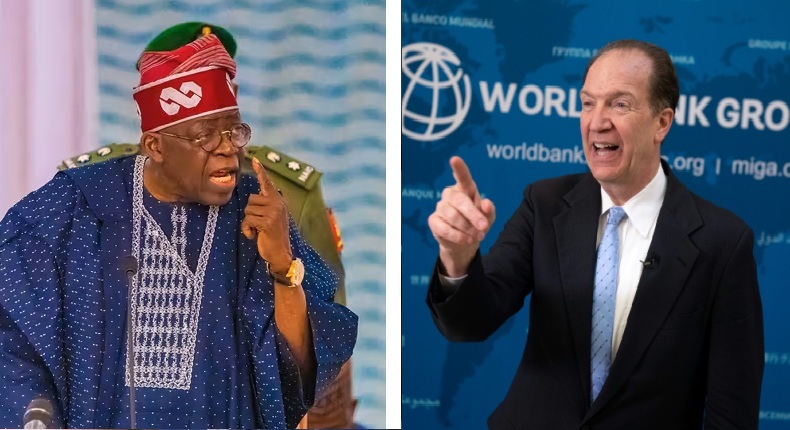
In June, it was reported that the International Monetary Fund (IMF) raised concerns over Nigeria’s proposed $5 billion borrowing arrangement with First Abu Dhabi Bank, warning that such financial structures may be opaque, complex and difficult to fully assess in terms of risk exposure.
Christian Ebeke, the IMF’s mission chief for Nigeria, said instruments such as Total Return Swaps (TRS) often lack transparency, making it harder for stakeholders to evaluate their terms and long-term fiscal implications.
“Our view is that transactions in these types of structures carry risks. Usually they are opaque, so the terms are not always very transparent when we review these instruments across countries,” Ebeke told reporters following the Fund’s latest Article IV consultation.
In July, the former World Bank President David Malpass warned that Nigeria’s strategy of pledging national assets to secure loans could backfire.
He warned that this approach makes it much harder for the country to restructure its debt if a financial crisis hits