







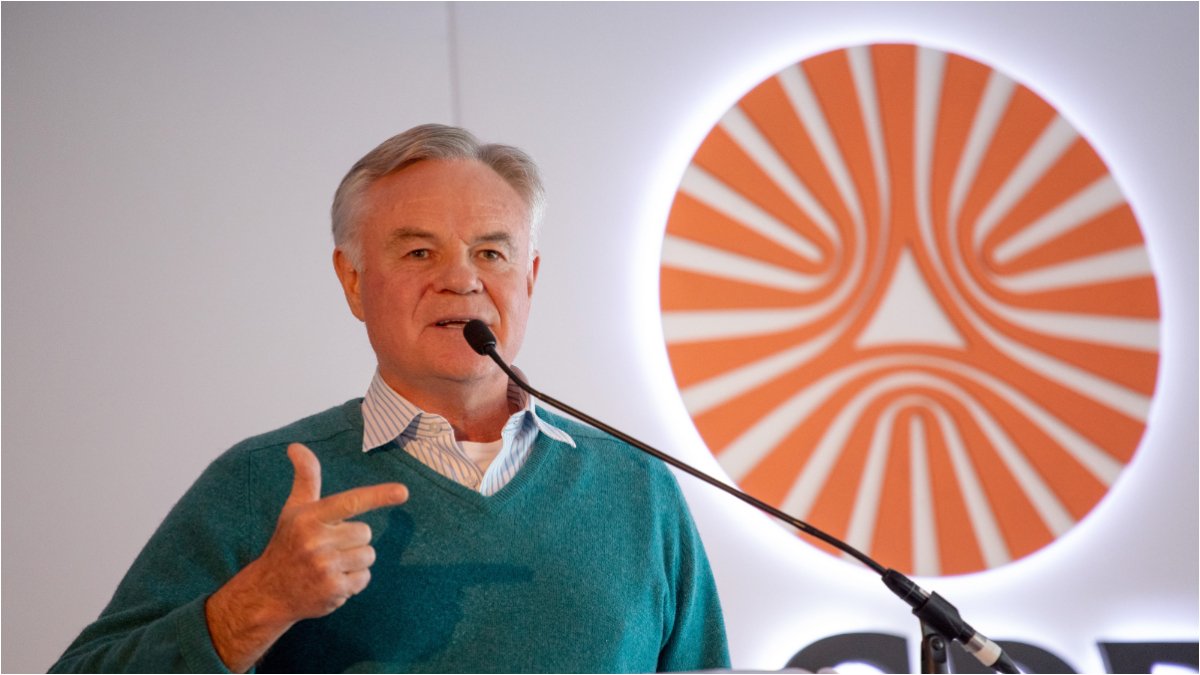
![Koos Bekker, the South African billionaire who chairs Naspers and its global technology subsidiary, Prosus.. [Photo: Dwayne Senior/Bloomberg via Getty Images]](https://ocdn.eu/pulscms/MDA_/dae393cb99f59c54f6a014770a86468e.jpg)
Prosus, the global technology investor majority-owned by South Africa’s Naspers, is positioning itself for a new wave of artificial intelligence that could move robots from controlled factories into warehouses, businesses and other workplaces.
- Prosus expects AI-powered robots to become commercially viable as hardware costs fall and training data improves.
- The company estimates useful general-purpose robots could cost about $20,000 within a few years.
- Warehouses, logistics and industrial inspection are likely to adopt the technology first, with China’s EV supply chain helping cut costs.
- Africa could benefit in mining, ports and agriculture, but high costs, infrastructure gaps and job concerns may slow adoption.
The Amsterdam-listed company said in a new position paper that advances in artificial intelligence, falling hardware prices and access to better training data were bringing general-purpose robots closer to commercial use.
Prosus estimates that a genuinely useful general-purpose robot could cost about $20,000 within a few years. At that price, the company believes robots could become economically attractive across large parts of the global economy.
The investment group is chaired by South African billionaire Koos Bekker, who also chairs Naspers. Bekker has an estimated fortune of $3.6 billion, according to Forbes Africa’s 2026 billionaires list.
However, Prosus is managed by Fabricio Bloisi, who became group chief executive in July 2024. Bekker is its non-executive chair and did not personally announce the new robotics strategy.
Prosus expects a major robotics breakthrough
Prosus compared the current state of robotics with the period before generative AI became commercially useful.
It expects the industry to reach what it calls its “GPT-3 moment” within about a year. This would mean robotic models becoming reliable enough to perform clearly defined tasks in real workplaces.
DON’T MISS THIS: SA’s most valuable firm invests in robots that can learn ‘every possible sequence of actions’
A more advanced stage, described as the industry’s “GPT-4 moment”, could follow within another few years. At that point, robots could be capable of completing many simple tasks after receiving instructions in ordinary language.
Prosus said the reliability of robots performing narrow tasks had increased from about 65 per cent in 2023 to as much as 99.9 per cent, while the amount of data required to train the systems had fallen.
These figures and timelines are Prosus’s projections and do not guarantee that general-purpose robots will reach mass adoption within the stated period. Safety, regulation, energy requirements and the ability to operate in unpredictable environments remain major obstacles.
“Robotics is where AI stops living on a screen and starts doing real work in the physical world,” said Thiago Viana de Silva, global head of Prosus Ventures.
![AI-powered robots could find early applications in warehouses, logistics operations and industrial inspection.[Gemini Generated Image]](https://ocdn.eu/pulscms/MDA_/c053a447b01c08d8c282ea2a8c176822.jpg)
The company expects warehouses, logistics operations and industrial inspection to be among the earliest areas of adoption. Consumer services and hospitality could follow, while construction and healthcare may take longer because of their more complex and safety-sensitive environments.
China’s electric vehicle industry is making robots cheaper
Prosus said the declining cost of robotic hardware was being supported partly by China’s electric vehicle supply chain.
Components used in electric vehicles, including batteries, motors, sensors and actuators, can also be used in robots. Expanding Chinese production has made some of these components cheaper and more widely available.
This could reduce one of the biggest barriers to adoption. Businesses have historically had to justify the high upfront cost of robots that were often limited to one repetitive task.
DON’T MISS THIS:An OpenAI-backed humanoid robot startup says it’s moving away from using humans to train its Optimus rival
AI-powered machines are expected to be more adaptable. Instead of being programmed for a single production line, they could learn different tasks and operate across several types of hardware.
The global industrial robotics market is already expanding. The International Federation of Robotics said factories installed 542,000 industrial robots in 2024, more than twice the number recorded a decade earlier. Asia accounted for 74 per cent of the new installations, compared with 16 per cent in Europe and nine per cent in the Americas.
Prosus has already invested in humanoid robotics
In November 2025, Prosus Ventures participated in a $50 million Series A funding round for Switzerland-based Flexion Robotics.
Flexion is developing an artificial intelligence system for humanoid robots rather than manufacturing the physical machines. Its software allows robots to practise tasks in simulated environments before applying what they have learnt in the real world.
Prosus did not disclose how much it contributed to the funding round.
The group has now mapped 85 robotics companies across five parts of the industry, including developers of foundation models, hardware manufacturers, integrated robotics companies, specialised applications and supporting infrastructure.
Prosus Ventures said it has invested more than $2.3 billion in over 100 start-ups across 20 countries since 2015. During its 2025 financial year, the division committed or invested more than $400 million, including $88 million in AI-related businesses.
DON’T MISS THIS:Sam Altman is quietly backing a stealth startup that’s building software for robots and cars
Where Africa fits into the robotics bet
Prosus’s map concentrates on companies in the United States, Europe and Asia. No African robotics ecosystem was identified as a major centre in the company’s announcement.
Nevertheless, Prosus retains an important African connection. Naspers, which is based and listed in South Africa, is the majority owner of Prosus. Prosus also has secondary listings on the Johannesburg Stock Exchange and A2X.
Its performance therefore affects Naspers and investors exposed to the group through South Africa’s capital market. Prosus’s financial results account for almost all of Naspers’s results.
The group reported ecosystem revenue of $9.7 billion for the year ended March 2026, while adjusted earnings before interest, taxes, depreciation and amortisation rose 84 per cent to $1.3 billion. Its free cash flow reached $1.5 billion.
Africa could eventually become a market for the machines and software being funded by Prosus, particularly in mining, ports, warehouses, agriculture and industrial inspection.
In mining, robots and autonomous equipment could reduce workers’ exposure to rockfalls, toxic gases and dangerous underground machinery. At ports and warehouses, robotic systems could help with cargo movement, inventory management and inspection.
However, a $20,000 machine would remain expensive for many African businesses. Unreliable electricity, limited technical expertise, currency weakness and the cost of importing and maintaining equipment could also slow adoption.
There are employment concerns as well. Africa has a young and rapidly growing workforce, making automation politically and socially sensitive. The immediate opportunity may therefore lie in using robots for dangerous, highly repetitive or difficult-to-fill jobs, rather than replacing workers across entire industries.