





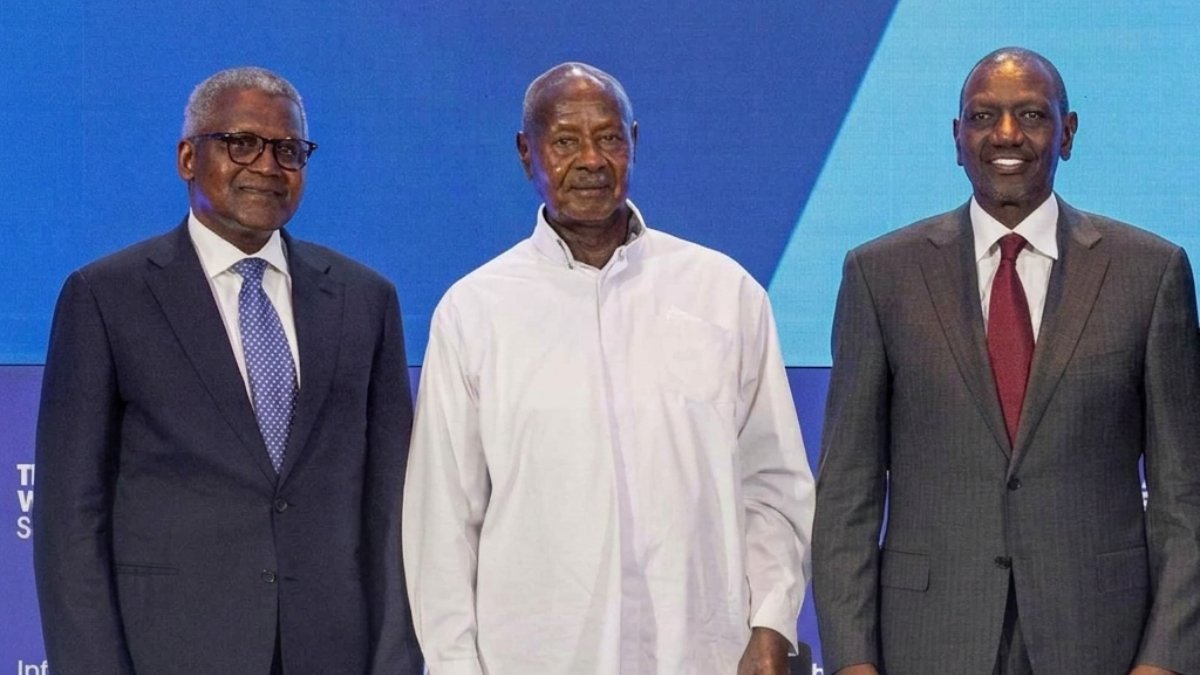
![L-R: Africa's richest man and founder of Dangote Group, Aliko Dangote; President Yoweri Museveni of Uganda and President William Ruto of Kenya. [X, formerly Twitter]](https://ocdn.eu/pulscms/MDA_/74a7191e22623b26a9fcb72202dde074.jpg)
Africa’s richest man, Aliko Dangote, in a recent interview with the BBC, disclosed that his proposed refinery in Kenya might cost substantially less than the $17 billion originally predicted, as the tycoon hopes to use lessons learned from the construction of his gigantic Lagos refinery to speed up the new project.
- Aliko Dangote announced that the planned refinery in Kenya will cost between $15.5 and $16 billion, lower than the initially projected $17 billion.
- He emphasized that lessons from building the Lagos refinery will allow the project to finish in less than four years, saving both time and financing costs.
- The refinery, to be located in Lamu, will become one of Africa’s largest and is part of broader regional collaboration plans.
- Dangote stated the project will be funded by a 30% equity and 70% debt mix, with no anticipated fundraising difficulties.
In the interview, Dangote stated that the Kenyan refinery will now require an investment of $15.5 billion to $16 billion.
Dangote hopes to finish the Kenyan project in less than four years, as opposed to the Dangote Refinery in Lagos, which took far longer to develop.
During the interview, when he was asked how much the refinery would cost, the Nigerian billionaire stated: “We told you it was going to cost $17 billion, but it’s going to cost less than that; we are looking at $15.5 and $16 billion.”
“Because this one will be faster, so financing cost will be less, and then also, we are wiser as a company than when we built this (the Dangote Refinery in Lagos), because we were just learning when we built the one here, so in terms of timing, we will be able to build in less than 4 years,” he told the BBC.
Furthermore, the Nigerian billionaire stated that the project will be funded by a combination of stock and debt, with equity accounting for around 30% of the investment and loans supplying the remaining 70%, when asked about financing plans.
“We are looking at all that, equity and debt; 30% is going to be equity, and 70% is going to be debt; we don’t have any problem raising money,” he added.
Lamu refinery takes shape
The projected plant, located in Lamu on Kenya’s northern coast, is slated to become one of Africa’s largest refineries once finished.
![L-R: Chairman Dangote Refinery, Aliko Dangote and Tanzania's President Samia Hassan. [X, formerly Twitter/@ikulumawasliano]](https://ocdn.eu/pulscms/MDA_/c95638969b3e8bf36d52a21a1fdc6a92.jpg)
The project began as part of negotiations between Kenya, Tanzania, Uganda, South Sudan, and the Democratic Republic of the Congo over the creation of a regional refinery. Tanga, Tanzania, was considered a prospective destination before Dangote changed his mind and chose Kenya.
Earlier reports show that Dangote’s revelation in the BBC interview is not far off from initial plans.
Since the news of Dangote’s plan to build a refinery in East Africa broke, Dangote has admitted that the finance plan for the project will draw on a variety of sources, including internal cash flows, loans, and stock.
Currently, the Dangote Group is also preparing to seek financing with the Dangote Petroleum Refinery & Petrochemicals IPO.
The firm plans to raise $5 billion during an initial public offering that is slated to close in October 2026, with the Nigerian Exchange serving as the principal listing venue.
![Lamu, Kenya. [guardian]](https://ocdn.eu/pulscms/MDA_/ac8bd23a52351c8e6a3d4adfe4aa4b4a.jpg)
Kenyan investors might also play a key role in the fundraising, with some sources saying that the country’s capital markets could contribute up to $500 million, potentially attracting participation from pension funds and other institutional investors.
In the same BBC interview, Dangote revealed that the refinery could begin construction as early as October this year.
“We’ve gone very far, and I think by October we would be doing groundbreaking; once we break ground, we would start the construction,” he stated.